Principle first:
Priority /pry · aw · ruh · tee/ noun. A thing that is regarded as more important than others.
🧠Today’s Framework: Prioritization with Matrices
📚Today’s Story: Jobs’ Power of Focus
Today’s Quote:
“Deciding what not to do is as important as deciding what to do. It’s true for companies, and it’s true for products.”
– Steve Jobs, as described in the Walter Isaacson biography
📚The Story: Job’s Power of Focus
Steve Jobs co-founded Apple in 1976 with Steve Wozniak and Ronald Wayne.
He hired John Scully to be CEO in 1983.
Scully forced Jobs out of the company in 1985.
Jobs went on to found NeXT Computers and Pixar.
Jobs returned in 1997 when Apple’s board bought NeXT.
Apple had lost $1.04B in the 1997 fiscal year.
He became interim CEO on September 1997.
He had inherited a mess:
Apple Computer, Silicon Valley’s paragon of dysfunctional management and fumbled techno-dreams, is back in crisis mode, scrambling lugubriously in slow motion to deal with imploding sales, a floundering technology strategy, and a hemorrhaging brand name.
Apple’s sales had plummeted by a frightening 32%, to just $2.1 billion, creating a stunning $120 million loss.
- Schlender, Brent. Fortune Magazine, March 3, 1997.
They were selling a dozen versions of the Macintosh.
Jobs asked the team: “Which do I recommend to my friends?”
There was no simple answer.
They sold servers. And network equipment.
They were selling a white labeled HP LaserJet printer called the StyleWriter.
“You are going to ship a millions and and not make any money on these? This is nuts!”
So he cut the product line by 70%.
A year later, Apple turned a profit of $309M.
Here’s how he did it:
He drew a 2×2 matrix on a whiteboard. He labeled the columns “Consumer” and “Pro”. He labeled the rows “Desktop” and “Portable”.
When he was done, they had 4 products: Power Mac G3 Desktop, PowerBook G3 Laptop, iMac, iBook.

“I freed up some good engineers who could work on new mobile devices. And eventually we got it right when we moved on to the iPhones and the iPad.”
Apple had lost $1.04 billion when Jobs became interim CEO in September 1997. In the 1998 fiscal year, they turned a profit of $309 million.
Focus is a power tool.
Be sure you’re team knows what to focus on. Here are a couple frameworks I like to use.
🧠The Framework: Decision Matrices
The Eisenhower Matrix
Stephen Covey drew what is often referred to as the Eisenhower Matrix in his book 7 Habits of Highly Successful People.
Here’s what it looks like:

This matrix divides tasks into four categories based on urgency and importance:
- Urgent & Important (Box 1): Tasks requiring immediate attention. Firefighting happens here.
- Important, Not Urgent (Box 2): Tasks that drive long-term value. Focusing on these helps prevent future crises.
- Urgent, Not Important (Box 3): Tasks that feel pressing but add little value. Delegate these.
- Not Urgent, Not Important (Box 4): Time-wasters. Eliminate these.
We want to minimize the activities in Box 1. This is where we are Reactive. This is fire fighting.
We do this by concentrating on Box 2 activities. This is not easy, there is nothing external forcing us to completion. There is no alligator next to the boat. We have to set our own priority, our own deadline, and drive this to closure.
If we don’t, things creep up in Box 1.
Application for teams: Encourage your team to constantly review their tasks through this lens. By reducing time spent in Box 1 and eliminating Box 4, the focus can shift to Box 2—the real growth zone.
The Impact/Effort Matrix
I first read about this in the workshop design book book Gamestorming by Dave Gray et al. (This book is a must for anyone running collaborative workshops. And if you have a team you SHOULD be running collaborative workshops.)
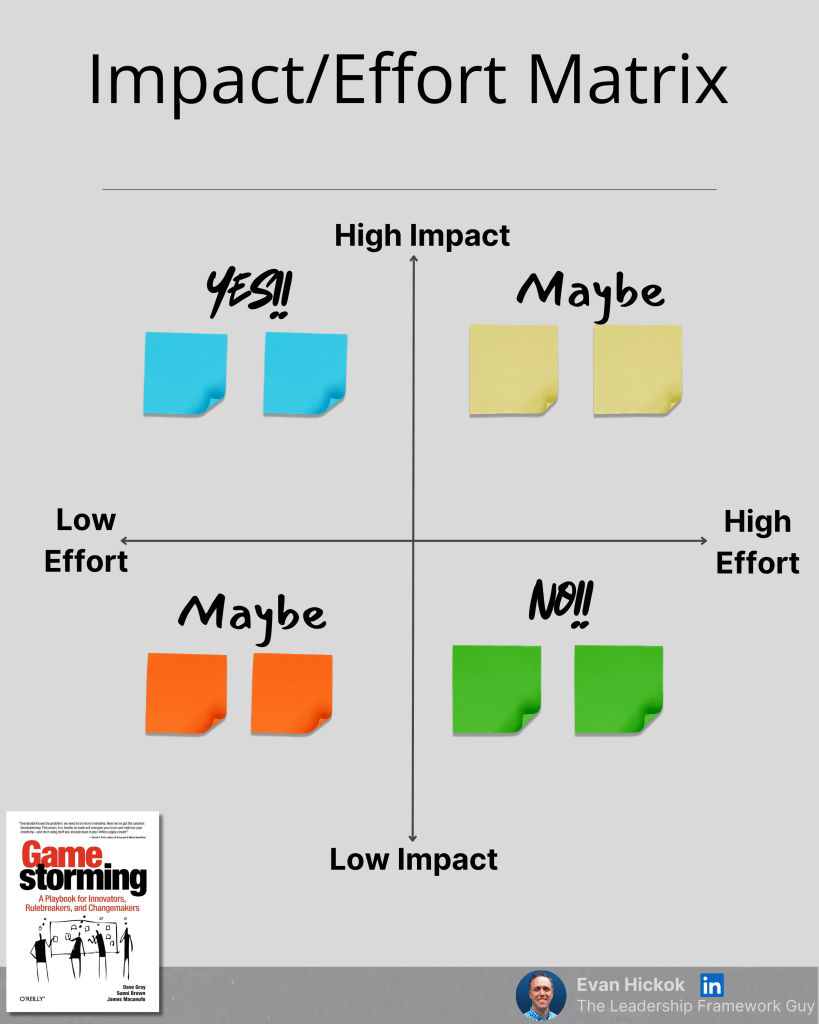
This feels pretty self explanatory. This framework helps teams decide where to focus based on the impact of an initiative and the effort required to implement it:
- Low Effort, High Impact: The sweet spot. These are the tasks that should get immediate attention.
- High Effort, Low Impact: These tasks should be deprioritized or killed off. Avoid spinning your wheels here.
- High Effort, High Impact: Requires careful consideration—these may be worth pursuing with proper resources.
- Low Effort, Low Impact: Avoid unless there’s spare capacity.
Application for teams: Use this matrix in collaborative workshops to prioritize projects. It helps ensure that the team’s energy is spent on tasks that will deliver the most return for the effort invested.
Focus is a leadership superpower. Jobs’ ability to strip Apple down to its core competencies demonstrates that leaders must often make hard choices to focus their teams on what truly matters.
Leverage decision matrices. These tools can help managers prioritize their tasks and avoid being overwhelmed by non-essential work.
Drive long-term value. By focusing on what’s important (Box 2 in the Eisenhower Matrix) and investing in high-impact, low-effort initiatives, teams can ensure they’re building for the future rather than constantly putting out fires.
Remember – the theme here is focus. We generate several options, and then classify them by their impact – low or high, and the effort to implement – low or high. These scales are relative.
If you find options in the Low Effort/High Impact quadrant, these should be green lighted.
Anything High Effort/Low impact should be killed. These are a hard no.
The other quadrants are maybes. You’ll
Remember the importance of establishing alignment, and creating project charters where necessary.
Your team will thank you for the clarity.
