Why does this feel so frustrating?
Picture a group of six-year-olds playing soccer.
The ball rolls down the field, and suddenly, every single player is chasing after it—no spacing, no passing, no plan. They swarm to wherever the action is, tripping over each other, all trying to kick the ball at the same time.
Nobody is playing defense. Nobody is running ahead to receive a pass. Nobody is in goal.
It looks like this:

Nobody is thinking about positioning or strategy.
Now imagine being the coach, standing on the sideline, watching this unfold. It’s painful. It’s chaotic, inefficient, and frustrating—not because the kids aren’t trying hard, but because they don’t have a structure that lets them win. And what do the parent’s yell?
“Spread out!”
In business, this is where managers start quoting Jim Collins “We’ve got to get the right people on the bus!”
The right people are important, but too many managers take this idea out of context and apply it too broadly. They didn’t read the whole book and they forget the rest of Jim Collins’s Level 5 Leadership including the concept of the Window and the Mirror which I’ll paraphrase:
When we succeed, the Level 5 leader looks out the window and says ‘Look what you have accomplished.’ When we fail, the Level 5 leader looks in the window and asks ‘How can I improve?’
Now – these kids are still developing ball handling skills. This is not your team. Your team is skilled – well educated, deep experience. But their results are still poor.
So what is the other difference between those kids and this:

Structure.
The difference is structure. This team is using the entire field – all of the work of the organization is getting done. Offense, defense. It’s more than where the ball is – people are moving without the ball creating opportunity.
I see this all the time missed by teams.
It is not a people problem—it’s a structure problem.
And the reality is, many organizations unknowingly operate exactly like this.
The Chaos of a Poorly Designed Organization
Most businesses assume that hiring top talent guarantees success. But without the right organizational structure, even the best teams struggle. Just like in soccer, where strategy and positioning matter more than raw skill, businesses need structure to win.
When an organization lacks structure, it plays out just like a disorganized soccer game:
- Everyone chases the same problem – Instead of specialized teams focusing on their responsibilities, people swarm to the latest crisis, project, or customer request.
- Work overlaps, and nothing gets fully owned – People keep retouching the same task, but the quality still suffers because nobody truly owns it.
- Work gaps cause critical responsibilities to be ignored – Essential but less visible work—like risk management, integration, and forward planning—gets neglected, creating a reactive culture.
- The organization struggles to adapt – When an urgent issue arises, nobody is positioned to handle it. The team is always behind, reacting instead of proactively planning.
Just like the kids on the soccer field, people are frustrated. They’re trying hard. They’re running fast. But somehow, the team still isn’t winning.
What a Strong Vertical Organizational Structure Looks Like (Lessons from Soccer)
If this kind of chaos causes teams to lose games in soccer, why do we accept it in organizations?
If it’s not a people problem but a structure problem, how do we build a structure that actually works?
A well-structured organization functions like a professional soccer team:
- Clear roles – Each player has a distinct position: defenders, midfielders, strikers, goalkeepers. They don’t all chase the ball – they are proactive: they spread out, create opportunities, and manage risk.
- Coordination – Players communicate and trust the system, ensuring seamless transitions from defense to attack.
- Adaptability – The team can react to changes on the field because everyone knows their role and how to adjust without chaos.
The manager of a pizza shop’s job is to enable the people making pizza to meet and exceed their customers’ expectations. How do they do that?
- Clear roles – Each task is laid out with success criteria enabling training, and coaching: making dough, making sauce, making pizza, taking orders, fulfilling orders.
- Coordination: Teammates talk amongst themselves, self-managing their interdependencies—”We are getting low on sauce. Can someone spin up another batch?” “I need a Diet Coke so this order can go out the door.” “I cannot make it to work on Friday. Can someone cover?”
- Adaptability—In the lull after the lunch rush, the team prepares for the dinner rush. They correct their own and each other’s mistakes so that all the customer sees is a perfect order.
Who wouldn’t want to work in that environment?
It’s the manager who creates this environment. This is not “doing” work. This is “enabling” work.
Here is one framework that should be executed throughout a vertical structure.
Triple-Loop Learning
I found this concept in a book by Robert Hargrove called Masterful Coaching. I found the idea compelling, but I couldn’t quite get it to click. So I read his sources and this quote answered all my curiosity:
“Policy issues at the level of a lower (layer in the organization) is the work at the level of the next higher (layer in the organization).”
– Georges L. Romme, A., and Arjen Van Witteloostuijn. 1999. “Circular Organizing and Triple Loop Learning.” Journal of Organizational Change Management 12 (5): 439–54. https://doi.org/10.1108/09534819910289110.
See, the role of a manager is to enable those below, whatever layer you are at. A senior manager enables the manager who enables the front line. Each layer has to perform a higher level of thinking.
“The significant problems we face cannot be solved at the same level of thinking we were at when we created them.” – Albert Einstein
So how do we get to a different level of thinking?
Here’s a framework: Tripe Loop Learning
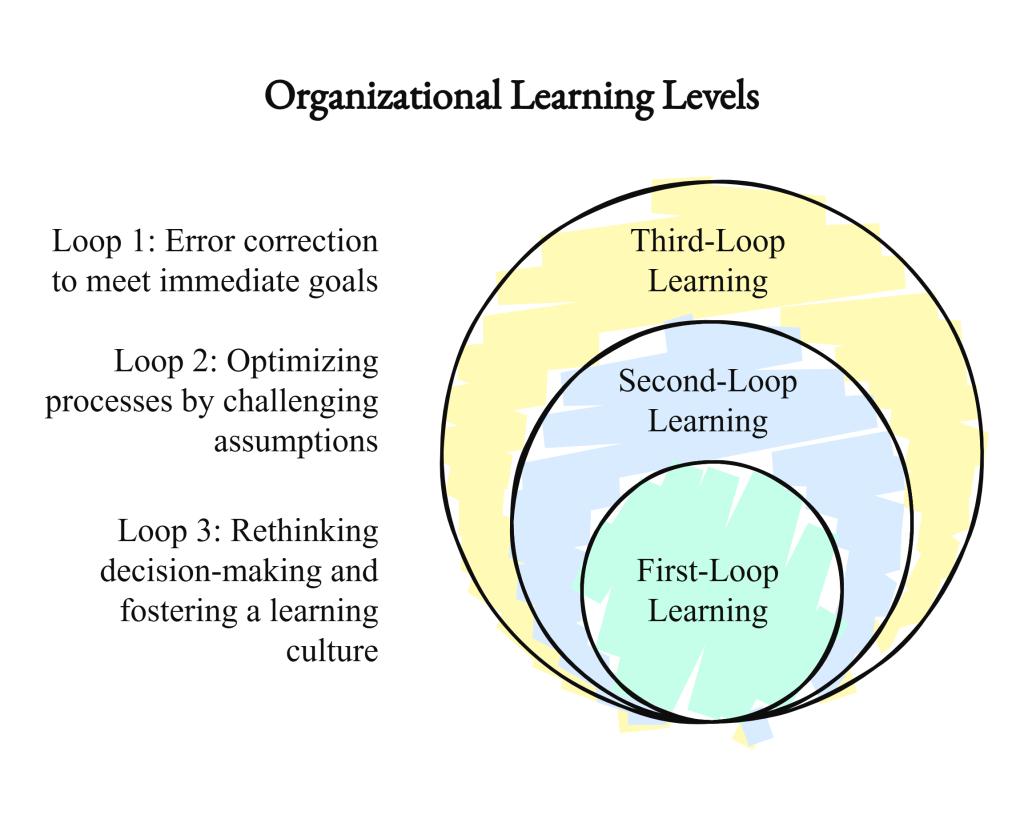
1. First-Loop Learning: Tactical Execution
- Question: Are we doing things right?
- Focus: Error correction, improving actions and behaviors to meet existing goals. There is no questioning of underlying assumptions.
- Example: The pizza delivery guy brings the customer a pepperoni pizza, but they ordered cheese. First loop learning: fix the error – return with the cheese pizza.
2. Second-Loop Learning: Optimizing the System
- Question: Are we doing the right things?
- Focus: Challenging assumptions and improving processes.
- Example: The pizza shop manager notices a trend of customer dissatisfaction. Second loop learning: She pulls the thread and notices customers often receive the wrong order, both in person and on delivery. She looks at the processes the team uses to collect and fulfill orders and improves them to enable the front line to deliver more consistent results.
3. Third-Loop Learning: Rethinking How We Decide
- Question: How do we create a culture where learning is the norm?
- Focus: Creating “collective mindfulness” in the organization, one where learning is facilitated.
- Example: The pizza shop owner recognizes trends in the industry – app-based ordering, plant-based ingredients, and trending flavors and builds a strategy to stay just behind the bleeding edge of these ideas. They also create a culture where learning is enabled at all levels – managers are enabled to question norms and improve processes, and the front line is enabled to point out issues to help the managers find their work. This, of course, takes psychological safety. Remember when Dominos Pizza reinvented their recipe? That was triple-loop learning in action.
Conclusion: From Chaos to Championship
Most organizations don’t fail because of bad people—they fail because of bad structure. The difference between a chaotic, ineffective team and a high-performing one isn’t just effort, intelligence, or even talent—it’s the system that enables them to win.
Just like in soccer, businesses need clear roles, coordination, and adaptability. The most effective organizations aren’t the ones constantly reacting to problems but the ones that have built a framework for continuous learning and improvement.
Triple Loop Learning provides that framework. It moves teams beyond just fixing errors and optimizing processes to fundamentally rethinking how decisions are made and how work is structured.
The best leaders don’t just get the right people on the bus—they build a bus that can navigate complex terrain, adapt to changing conditions, and drive itself toward success.
So the real question isn’t just Are we doing things right? or Are we doing the right things? but Are we creating a system where learning, adaptation, and improvement are the norm?
My mantra: What can I do to enable the people BELOW me? That is my work.
Because when we get the structure right, the team wins—again and again.

2 thoughts on “Why Organizational Structure, Not Talent, Defines Business Succes”