
How to build team alignment: the JFK Play in 3 steps
How Kennedy built a Why that outlived him — and the framework any manager can run.
The President walked into the building unannounced.
Cape Canaveral. Late. A custodian was mopping the floor of a corridor when Kennedy came through with his entourage. The President stopped. He asked the man why he was working so late.
The custodian stopped mopping. He looked up.
“I’m not mopping floors. I’m putting a man on the moon.”
That story has carried me for years.
In 2024 I went to Kennedy Space Center to see the hardware. I saw the Vehicle Assembly Building — for a time the largest building in the world. I saw Launch Complex 39A. I met astronaut Mike Baker. I stood under the Saturn V — the largest rocket ever flown. And the whole time I kept wondering how a goal this big had ever come into existence. How one man in 1961, facing a Soviet Union that had just put the first human in space, had decided to commit a nation to landing a man on the moon — and how that goal had carried 400,000 people, including the custodian at Cape Canaveral, for the decade that followed.
Here is what I found.

That custodian didn’t sit in the Cabinet Room. He didn’t read the cost projections. He hadn’t watched Yuri Gagarin orbit the Earth on television and felt the world shift under American feet. He didn’t share Kennedy’s Cold War anxiety or his budget math. He shared the goal. The goal Kennedy had declared a year earlier at Rice University, on a hot September afternoon in Houston:
“We choose to go to the moon in this decade and do the other things, not because they are easy, but because they are hard.”[5]
That was the Why the custodian had heard. He was one of 400,000 people who could have answered the same way. Technicians, engineers, welders, administrators, janitors — all carrying the same answer, all working inside the same Why.
That is the work a well-built Why does. It creates shared purpose around the What. It lets people who don’t share your reasons share your goal. Build it well enough and a custodian, mopping a floor in the middle of the night, will tell you exactly what he’s doing.
This essay is about how to build team alignment the way Kennedy did — by asking first, declaring second, and tending the Why on a cadence.
Kennedy didn’t walk into a room and declare that goal into existence. He ran a deliberate, structured process — thirty-five days, five questions, four advisors, one report — before he said a single word publicly about going to the moon. Most managers announce the goal. Kennedy asked questions first.
The difference between declaring and consulting, between broadcasting and building, is the difference between a goal people follow because they were told to and a goal people carry because they share it. Here is exactly how he did it. And at the end, the process you can run on your own team.
The story sits in five letters and a recording, most of which lived in the Kennedy Presidential Library for decades before most people read them. I’ve read them. Here’s what I’ve learned.
Step 1: Start a stakeholder loop
April 12, 1961. The Soviet Union put Yuri Gagarin into orbit — the first human being in space. Kennedy’s advisor Theodore Sorensen would describe it on the record, three years later, as a moment when “the Soviets had scored a tremendous propaganda victory, that it affected not only our prestige around the world, but affected our security as well in the sense that it demonstrated a Soviet rocket thrust which convinced many people that the Soviet Union was ahead of the United States militarily.”[1]

Kennedy knew something had to be done. He didn’t yet know what.
For eight days he carried that. A President with the world reading him as weak, with the Soviet rocket capability now demonstrated in front of every newspaper photographer on Earth, and no answer in his pocket. He could have announced a response — Cold War theatre demanded one. He didn’t. On April 20, he sat down and wrote five questions instead.
He sent them in a one-page memorandum to Vice President Lyndon Johnson, who chaired the National Aeronautics and Space Council. The questions were specific:

The first question is the one that did the work:
“Do we have a chance of beating the Soviets by putting a laboratory in space, or by a trip around the moon, or by a rocket to land on the moon, or by a rocket to go to the moon and back with a man. Is there any other space program which promises dramatic results in which we could win?”
These are not the questions of a man who has already decided on his moon shot. They are the questions of a man who knows he has a space program, knows the nation needs it to do something big, and trusts his team to tell him what that big thing should be.
Kennedy did two other things in this memo. He noted that he had already spoken to the senior officials Johnson would need, ensuring their full cooperation. And he made the urgency clear, asking for a report “at the earliest possible moment.”
Johnson had answers nine days later.
Step 2: Assemble the picture
Johnson went to work. He consulted NASA Administrator James Webb, Secretary of Defense Robert McNamara, Science Advisor Jerome Wiesner, and leading members of Congress. He also reached out to the rocket engineer whose fingerprints were on every serious American launch vehicle of the era, and who would go on to design the Saturn V that put Neil Armstrong on the moon — Wernher von Braun.
Von Braun replied to the Vice President with a memo dated April 29, 1961. He worked through Kennedy’s five questions in order, with the precision you’d expect from an engineer. But when he reached Question 5 — Are we making maximum effort? Are we achieving necessary results? — something shifted.
His answer was no. And then, instead of stopping there, he told Johnson exactly what to do about it:
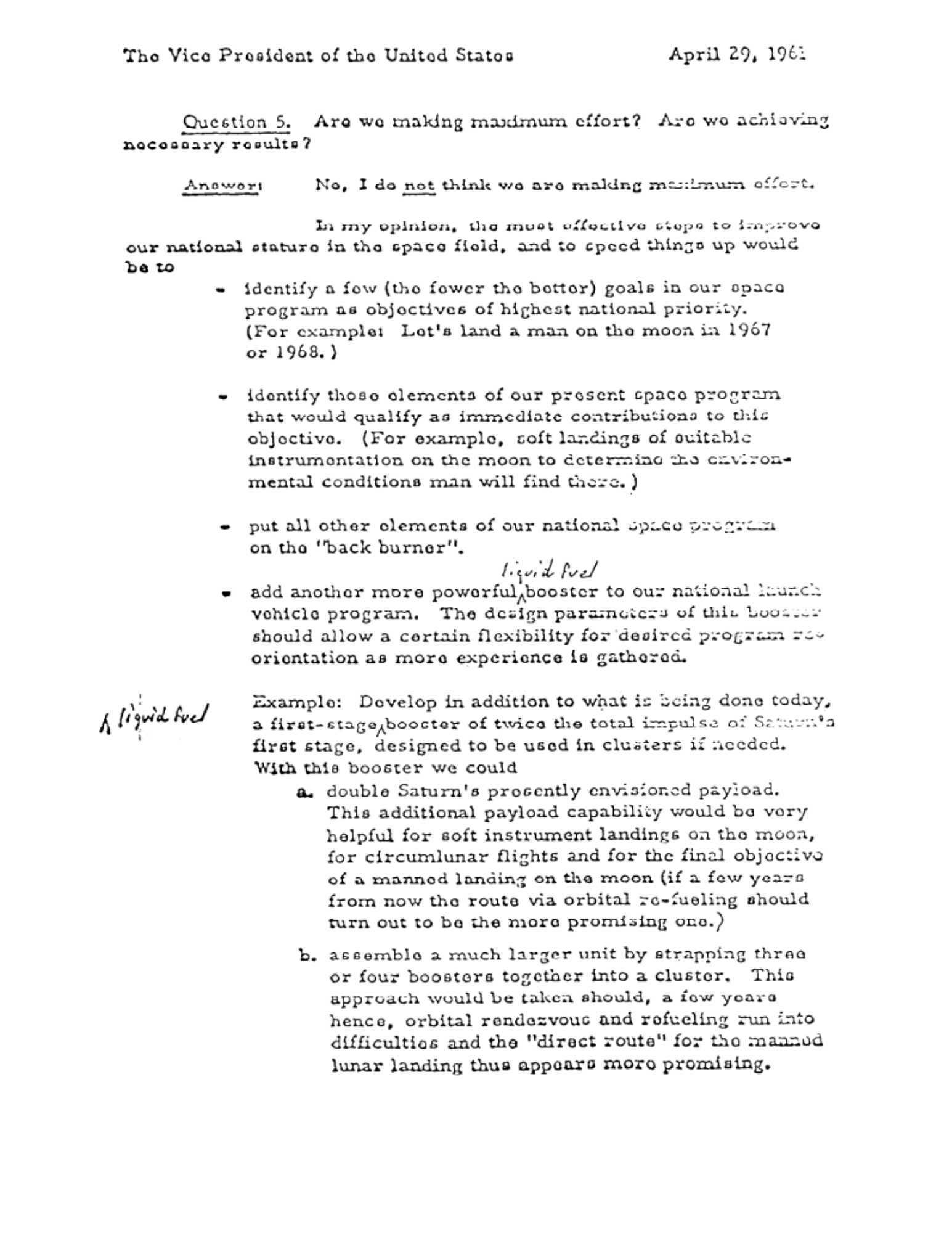
His Question 5 answer turned on a single rule:
“Identify a few (the fewer the better) goals in our space program as objectives of highest national priority. (For example: Let’s land a man on the moon in 1967 or 1968.)”
The fewer the better. One objective. Everything else on the back burner. And — quietly tucked in as the fourth bullet — and build the rocket the objective will require. Strategy and the engineering commitment to make the strategy real, in the same paragraph.
It came from the engineer.
Von Braun also explained why the Moon specifically. He walked through each option Kennedy had asked about. A laboratory in space: the Soviets could beat the U.S. by two years. A radio transmitter on the moon: the Soviets could do this essentially at will with the rockets they already had. A three-man crew around the moon: the Soviets could probably manage it by 1962 or 1963, if they were willing to waive the requirement to guarantee the crew’s safe return.
That last condition — a safe return — was a line the United States would not cross. It was a NASA ground rule. And it was, von Braun argued, exactly the constraint that created the American opportunity.
A manned lunar landing with return capability required, in his estimate, a rocket roughly ten times more powerful than anything the Soviets currently possessed. Neither country had it. The U.S. was behind on every other measure — but here, the race hadn’t started yet.
“We have an excellent chance of beating the Soviets to the first landing of a crew on the moon (including return capability, of course). The reason is that a performance jump by a factor 10 over their present rockets is necessary to accomplish this feat. While today we do not have such a rocket, it is unlikely that the Soviets have it.”
This was the crisis point. Kennedy now had a clear picture, and it was not a comfortable one: the only goal with a genuine American path to victory was also the hardest, the most expensive, the one requiring technology neither side had yet built. The easy options led to guaranteed defeat. The hard option led somewhere else.
He didn’t have to choose yet. But the picture was now clear.
Step 3: Write the Why — then let it outlast you
On May 8, 1961 — eighteen days after Kennedy sent his memo, thirty-five days after Gagarin’s flight — Webb and McNamara delivered their joint report to Johnson, who delivered it to Kennedy the same day. Their recommendation was clear: pursue space projects aimed at enhancing national prestige, with a manned lunar landing before the end of the decade as the primary objective.
Kennedy approved the recommendations.
On May 25, 1961, he stood before a joint session of Congress and stated the What:
“I believe that this nation should commit itself to achieving the goal, before this decade is out, of landing a man on the moon and returning him safely to the Earth.”[4]
The Why came a year later, at Rice University — the same speech that opens this essay. The line every schoolchild learns is “we choose to go to the moon… not because they are easy, but because they are hard.” But the speech does more work than that one line. Earlier in the same paragraph cluster, Kennedy framed the Why itself — larger than the What, more durable, pointed not at the Cold War but at something that would outlast it:
“Space can be explored and mastered without feeding the fires of war, without repeating the mistakes that man has made in extending his writ around this globe of ours. There is no strife, no prejudice, no national conflict in outer space as yet. Its hazards are hostile to us all. Its conquest deserves the best of all mankind.”[5]
Kennedy understood the difference between a What and a Why, and he gave them to the world on different timelines. The What was finite, political, Cold War-specific. The Why was infinite — framed so that anyone, regardless of their views on the Soviet Union, could work inside it.
The Why doesn’t need to be yours
November 21, 1962. The Cuban Missile Crisis had ended four weeks earlier. Eight men were seated around the table in the Cabinet Room, charts on the wall, the topic listed as supplemental appropriations for NASA.
The tape was running — one of the recorders Kennedy had installed in the room.
The meeting had been grinding through budget numbers for over an hour. Twenty-seven million in supplemental funding, schedule dates for Gemini and Apollo, contractor cost overruns. Webb was defending his program. Kennedy was pressing him.
The argument had reached the question of whether the Moon program should be declared the top priority of NASA. Webb resisted the label. He believed there was genuine public appetite for American preeminence in space that went beyond the race — that the scientists and engineers and universities who would carry the program forward cared about more than beating the Soviets, and that if Kennedy flattened everything into a competition, he’d lose them.
Kennedy didn’t agree. He said the quiet part out loud:
“[W]e’ve spent half the expenditures, we’ve wrecked our budget on all these other domestic programs, and the only justification for it, in my opinion, to do it in the pell-mell fashion is because we hope to beat [the Soviets] and demonstrate that starting behind it [them], as we did by a couple of years, by God, we passed them. I think it would be a helluva thing for us.”[6]
Six months later a custodian was mopping the floor of a corridor at Cape Canaveral. The President walked in. The custodian was asked why he was working so late.
“I’m not mopping floors. I’m putting a man on the moon.”
The custodian was not wrong. He was working inside Kennedy’s Why — not Kennedy’s private accounting, not the line on the budget, not the Cold War triangulation Kennedy had just admitted to Webb. The Why. The shared purpose Kennedy had built around the What.
That is what a well-built Why does. It transcends the conditions of its creation. It governs decisions its author never anticipated, in rooms the author never entered, by people who just needed to know where they were going. That is how to build team alignment that lasts: not by selling your reasons, but by framing a goal that doesn’t need them.
Build it well enough, and it runs without you.
The goal outlasted the man’s private doubts. It outlasted Kennedy himself, who was killed one year and one day after this very meeting. It continued to govern decisions made in rooms he never entered, by 400,000 people who shared none of his reasons but all of his goal.
How to build team alignment as a manager: the JFK Play
Kennedy could commission a report from the Vice President and get answers in nine days. You probably can’t. That’s not the point.
The shape of what he did is what scales. Specific questions, asked to the right people, before you have an answer. Then a synthesis. Then a Why framed so that people who don’t share your reasons can still share your goal.
Step 1 — Run the stakeholder loop.
Before you write a single word of your team’s purpose, go ask questions. In one-on-ones, ask your team members what they’re working on and why. Visit your peers and your manager and ask what they think your team’s purpose is. Reach outward to customers and stakeholders if you can get to them. Find where the answers converge and where they diverge. Bring the disconnects back. Kennedy didn’t start with an answer — he started with questions specific enough to actually produce one.
Step 2 — Write the Why.
Pull the raw material from your stakeholder loop into a single Why statement — the shared identity of the team. There will be themes in there tying everything together. Document both the Why (the infinite goal, the shared purpose) and the Whats (the finite projects and tasks that serve it). Keep them separate. Kennedy announced the What in May 1961. He articulated the Why a year later. Both matter. They are not the same thing.
Step 3 — Revisit on a cadence.
The Why gets checked at minimum quarterly. Every What gets evaluated against it. If it serves the Why, you do it. If it doesn’t, you prune it. Alignment is not a destination — it is a practice. A Why that isn’t tended becomes a poster on the wall. A Why that is tended becomes what the custodian says when someone asks why he’s mopping the floor at midnight.
Two times I’ve run this
The first time I built a Why for a large team — 160 people — I hired a consultant and ran a workshop. Twenty leaders showed up for a week. We walked out with something genuinely better than the imperfect draft I’d walked in with. And it worked. But it required resources I didn’t always have, and a mandate I wouldn’t always carry.
The last time I ran this process, I had a team of five. I had just arrived in another country on a new assignment, representing about 200 people who spent ten years designing an impossibly complex system I was to help install. I had no formal authority over most of the people I worked for and with. I visited my team, my boss, people above my boss, my peers, and several members of our customer. I asked everyone the same three questions:
- What is your vision for this team?
- Where do you see us in six months, one year, five years?
- Imagine it’s one year from now and this project is a disaster. What happened — and what can we do today to prevent it?
I brought all of it back to the team. Together, we distilled it into a Mission, Vision, and Values statement. We refer to it in a quarterly meeting and often in between.
That’s the Kennedy play with no Vice President, no Cabinet Room, and no institutional authority over most of the people in the loop. The loop works because of how you ask — specific questions, asked to the right people, before you have an answer — not because of what title you hold when you ask them. That is how to build team alignment when you can’t commission a report and don’t have nine days.
Alignment is one of the four pillars that separate high-performing teams from everyone else. The others are Cohesion, Psychological Safety, and Transparent Processes. If you want the complete framework — including more on how to build team alignment, cohesion, psychological safety, and transparent processes on your team — the pillar page below walks through all four in depth.
Related reading: How to build a high-performing team — the complete guide.
- [1]Theodore C. Sorensen, Oral History Interview JFK#1, conducted by Carl Kaysen, March 26, 1964. John F. Kennedy Presidential Library Oral History Program. Reprinted in John M. Logsdon, ed., Exploring the Unknown: Selected Documents in the History of the U.S. Civil Space Program, Vol. VII (Washington, DC: NASA History Division, 2008), Document II-43. JFK Library transcript PDF. ↩
- [2]John F. Kennedy, Memorandum for Vice President, April 20, 1961. Original held by the Lyndon B. Johnson Presidential Library, National Archives and Records Administration, Austin, Texas. Scan and exhibit page: U.S. Capitol Visitor Center, visitthecapitol.gov/artifact/memo-president-john-f-kennedy-vice-president-lyndon-johnson-april-20-1961. Reprinted in John M. Logsdon, ed., Exploring the Unknown: Selected Documents in the History of the U.S. Civil Space Program, Vol. VII (Washington, DC: NASA History Division, 2008), Document II-8, pp. 479–480. ↩
- [3]Wernher von Braun, Memorandum to Vice President Lyndon B. Johnson, April 29, 1961. Original in the von Braun papers. Scan: University of Alabama Huntsville Propulsion Research Center, uah.edu/images/research/prc/events/von-braun-white-house-memorandum.pdf. The Q5 bullet list quoted here appears on page 8 of the original letter. Reprinted in John M. Logsdon, ed., Exploring the Unknown: Selected Documents in the History of the U.S. Civil Space Program, Vol. VII (Washington, DC: NASA History Division, 2008), in the document cluster between II-8 and II-11. ↩
- [4]John F. Kennedy, “Special Message to the Congress on Urgent National Needs,” May 25, 1961. In Public Papers of the Presidents of the United States: John F. Kennedy, 1961 (Washington, DC: U.S. Government Printing Office, 1962), pp. 396–406. JFK Library transcript. ↩
- [5]John F. Kennedy, “Address at Rice University on the Nation’s Space Effort,” September 12, 1962. In Public Papers of the Presidents of the United States: John F. Kennedy, 1962 (Washington, DC: U.S. Government Printing Office, 1963), pp. 669–670. JFK Library transcript. ↩
- [6]Presidential Recording, Cabinet Room, November 21, 1962. Reprinted in Logsdon, Exploring the Unknown, Vol. VII, Document II-33, pp. 593–602; the quoted passage appears at 598–599. Audio: JFK Library, Presidential Recordings, Tape 63. NASA History transcript PDF. The 400,000-person figure is documented in Richard Hollingham, “Apollo in 50 Numbers: The Workers,” BBC, June 19, 2019, and corroborated by NASA Langley Research Center’s historical retrospective. ↩
- [7]“Soviet Orbits Man and Recovers Him; Space Pioneer Reports: ‘I Feel Well’; Sent Messages While Circling Earth.” The New York Times, Late City Edition, Vol. CX No. 37,699, Wednesday, April 12, 1961, page 1. Copyright The New York Times Company. Reproduced for editorial commentary under fair use. ↩