
How trusted brands collapse: the Sonos case study
A Sonos case study for product leaders: how leadership drift and ignored risk wiped out $1.2B in shareholder value — and what to learn before your next launch.
In college, my roommate Paul once convinced 32 dorm rooms to blast the same Tom Petty song in perfect sync.
It took charisma, coordination, and persistence — but when that jangly D-chord echoed down the hall, it was magic. It felt like the entire building was one big speaker.
Years later, Sonos productized that feeling. No charisma required. Just one tap — and your whole house sang together.
But in May 2024, they broke it. The Sonos controversy that followed wasn’t just a software incident. What broke wasn’t just the app — it was trust, loyalty, and the foundational architecture of their business. This Sonos case study unpacks how it happened — and what it means for any leader who’s drifted from their founding promise.
This story isn’t just about Sonos. It’s a Sonos case study in what happens when a company loses sight of its infinite goal. When it ignores risk it has clearly documented. When it prioritizes short-term launches over long-term trust. And fails to maintain the systems that once made it great.
If you’re a product leader, engineering manager, or executive, this story offers critical lessons in:
- How to manage technical debt before it becomes catastrophic
- Why risk mitigation is real work — not an afterthought
- How to use a company's original vision to stay aligned as you grow
- What happens when the CEO fails to hold the lighthouse steady in the fog
Sonos didn't collapse overnight. It drifted. Slowly. Predictably. Publicly.
And it didn't have to.
Let's walk through what went wrong — and how to keep it from happening in your own company.
🎧 The Collapse of Sonos — same case study, in your ears
Walk the seven-year risk disclosure with me. Includes the Gold-level dealer's ‘you have NO IDEA how bad this is’ thread.


Before Sonos
My freshman year college roomate, Paul, convinced all 32 rooms of the floor of our dorm to play Tom Petty’s song American Girl at full blast, perfectly synchronized.
This was the sort of thing that can only happen in college.
And Paul, the most charismatic person I’ve ever met, is the only person I know that could imagine and pull off a feat like this. It was legendary, and we all felt so cool being part of Paul’s plan.
It took about an hour — some people had it on CD, others on MP3, some on cassette. Getting all those people to press play at just the right moment until that famous jangly D-chord opening filled the hall perfectly synchronized was a feat of charisma, influence, and persistence.
And when it finally worked — when we all walked around the hallways and heard that song coming from every single room — it was just magic. It solidified Paul’s status as the legend of the 17th floor.
Sonos productized this
Years later, Sonos turned that same magic into a product. No coordination, no charisma — just one tap and music plays on countless speakers in perfect sync across your entire home — kitchen, living room, shower, wherever you place one of their speakers. We could have recreated Paul’s feat by simply placing a Sonos speaker in every one of those 32 rooms seamlessly and wire-free for the same effect. Of course, that would have taken about $8,000 of hardware — but Sonos was magic.

Sonos went public in 2018, but their stock has rarely seen daylight since. Except for a pandemic bump that lifted nearly every tech company’s stock, they’ve spent most of their public life underwater. Not because the market doesn’t believe in the product — but because the company keeps finding new ways to break the trust that product earned.
This is a company that could dominate the home audio space. They have the brand, the engineering talent, the customer love. But their track record tells a different story — one of repeated unforced errors, strange decisions, and leadership that seems out of sync with the very customers who made the company successful in the first place.
That May 2024 app update didn’t just introduce a few bugs — it shattered the illusion of a system that was praised for “just working.”
It triggered widespread system failures for millions of loyal Sonos users. Basic functions broke: volume control became erratic, alarms wouldn’t work, and speakers disappeared from the app. Within months, Sonos lost $1.2 billion in shareholder value — a 54% decline from its May 2024 peak — and cost the CEO, CMO, and CPO their jobs.
So what happened?
Sonos lost its way not because of a single mistake, but because it stopped managing risk as a leadership responsibility.
Not once, but twice in five years, the company made product decisions that alienated its most loyal users and wiped out billions in shareholder value. Both times, the technical failure was preceded by a management failure. Together, they created a breakdown in trust — internally and externally. And both times, the consequences were entirely predictable.
This is not just a postmortem. It’s a Sonos case study in what happens when leaders neglect risk and lost sight of their infinite goal which allowing a drift from their core product values. Sonos didn’t collapse overnight — it eroded, slowly and visibly. And in that erosion are lessons for anyone trying to build — or save — a great product.
I want whole-house audio
My grandparents had whole-house audio in the early 90’s.
They both served in World War II and met studying opera on the GI Bill at The New York College of Music. They had a music room full of opera records with speakers in the living room, and the kitchen. They could listen to Pucini’s La Boheme on vinyl or the Red Sox Game on WEEI wherever they were on the entire first floor. And these were not tech-savvy people. My grandfather retired from the music industry in 1992 when they asked him to start using a computer. Their whole-house audio in 1990 just required draping a few speaker wires around the house.
The immersive experience of whole-house audio is very pleasing. Sound placement matters. We have two ears, and we know when sound comes from ahead or behind. That’s what makes surround sound thrilling. And Sonos gets that — just look at this hero video I pulled from their homepage in 2025: wireless, immersive, seamless.
This love of immersive sound isn’t just about convenience. It’s cultural. It’s historical.
The Beach Boys’ use of Duophonic — sometimes called “mock stereo” — on their 1966 album Pet Sounds was groundbreaking. At the end of Caroline, No, the sound of a dog barking and a train sweeping from left to right had never been attempted before. It created a sense of motion and spatial awareness that hadn’t existed in recorded music. It set the stage for The Beatles’ stereo experiments for the second half of their album-making. And it paved the way for the sweeping stereo pans that became a hallmark of Pink Floyd’s Dark Side of the Moon in 1973 — an album that’s remained a best-seller for over fifty years.
Just put on Pink Floyd’s song Money with headphones and listen to the sounds of the coins in the left, then the right. It’s fascinating.
We don’t just want to hear music. We want to be surrounded by it. Moved by it. Located inside of it.
That’s the magic Sonos promised.
And that’s what I wanted.
I want to recreate what my grandparents had. I want the atmosphere my roommate Paul created in college. To be able to walk between rooms without the music fading.
But I don’t want to drape wires all over the place. I fear it’ll look sloppy, and hiding them in the walls is a lot of work and solidifies a room arrangement we weren’t prepared to set in stone.
So, I looked at Sonos back in 2012. But the more I researched, the more I realized it didn’t support the way I listen to music.
Their flagship product Play:5 launched at $399 — great sound, as long as you were streaming from a service like Pandora or Spotify. But I wasn’t that customer.
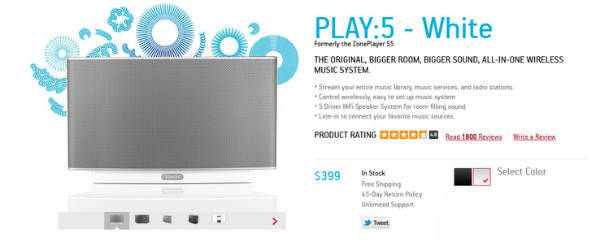
I had digitized thousands of CDs when iTunes came to Windows in 2004. I was a music-hunting kid. I discovered The Doors in a milk crate of used records in 1990. I remember putting the record on as soon as I got home, then running across the street to tell my best friend Mike. He’d just discovered a great new band, too. As it turned out, we had both just discovered The Doors. We were racing to share the same revelation!
I first heard a story of Syd Barrett, Pink Floyd’s original guitarist when I was 13. That he had lost his mind, thought he was a glass of orange juice and could no longer lie down for fear he’d spill. I had heard they wrote a song about him called Shine On You Crazy Diamond. But, pre-internet, this was not easy to confirm. I wondered about the song’s existence for a year and finally found it on a bootleg cassette at a flea market. It was so exciting! I still have it.
I’ve inherited my grandparents’ opera collection.
Music, for me, is deeply personal.
This is my music. Lots of this is not streamable.
To connect my music, I’d need to add a Sonos Connect for $350 — just to add a single line-in to accept a record player, or a computer output, or the occasional cassette. That’s $750 for the first room — with only one analog input.
And Sonos wasn’t truly wireless — not then.[1] I’d still have to drape ethernet wires to the other rooms. See, Sonos made all this wireless magic happen before most people had WiFi in their homes with their proprietary SonosNet mesh network. A brilliant solution. But to use that, I’d also need to buy a $50 Sonos Bridge. Now I’m at $800 just to hear my 20+ year old music collection in one room.
Each additional room? Another $400 Play:5.
Three rooms: $1,600.
That’s a steep price for the luxury of hearing the same song in the shower and while getting dressed without draping wires like my grandparents did. No thanks.
Then these two scenes convinced me Sonos was wrong for me.
First, I was in the locker room at work getting ready for a lunchtime run. There I am, fiddling with FitBit Ultra trying to get it to pair with my iPhone for what seemed like days. Meanwhile, my Boomer friend Bruce comes in, put on shorts and shoes, and went running tech free while I’m still untangling headphones. No tech, no fuss.
Second, Apple booted Google Maps off the iPhone in 2012 forcing people to use Apple Maps. Apple Maps was a terrible downgrade from Google Maps so iPhone users started moving to Waze. which Google then bought Waze foiling Apple’s vision of map dominance. Then Apple let Google Maps back on the iPhone.
That saga stuck with me. It showed how fragile these partnerships can be.
A licensing squabble between Sonos and their streaming partners, like Spotify, didn’t seem far-fetched. nd Spotify depends on its deals with the five major record labels. One broken agreement, and suddenly the whole ecosystem is compromised.
I didn’t want to spend $1600 just to get locked into a proprietary ecosystem that relied on multi-company agreements just to listen to music that I had owned on physical media since I was a teenager.
So what if I had to drape some wires? It’s what my Boomer friend Bruce would do. Tech free!
Boy was I right to be cautious.
In 2020, Sonos ended support for every product released in 2015 and before. If I had made that $1600 purchase in 2012, my system would have been garbage eight years later.
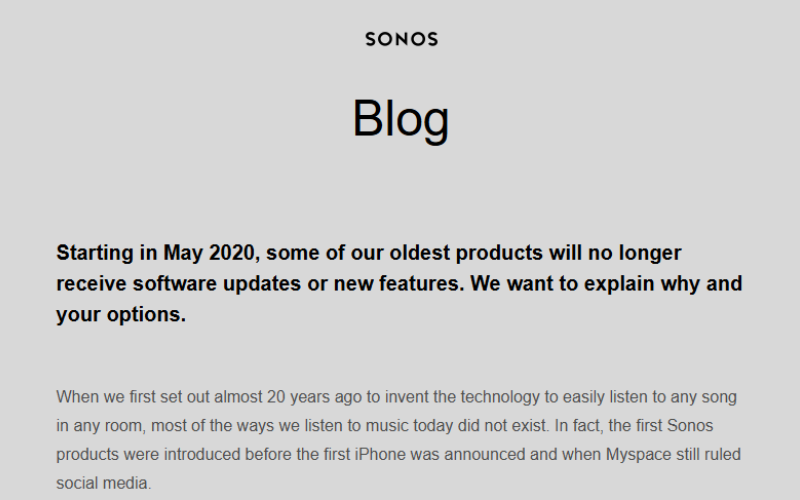
When I hesitated in 2012, I wasn’t even imagining that my purchase might have been considered so disposable so soon. My analog audio equipment works great, and likely will for a couple more decades. I would have been furious.
And people were — Sonos stock plummeted 59% over this, evaporating $1.2B of shareholder value. Their stock had just crept close to its IPO value.
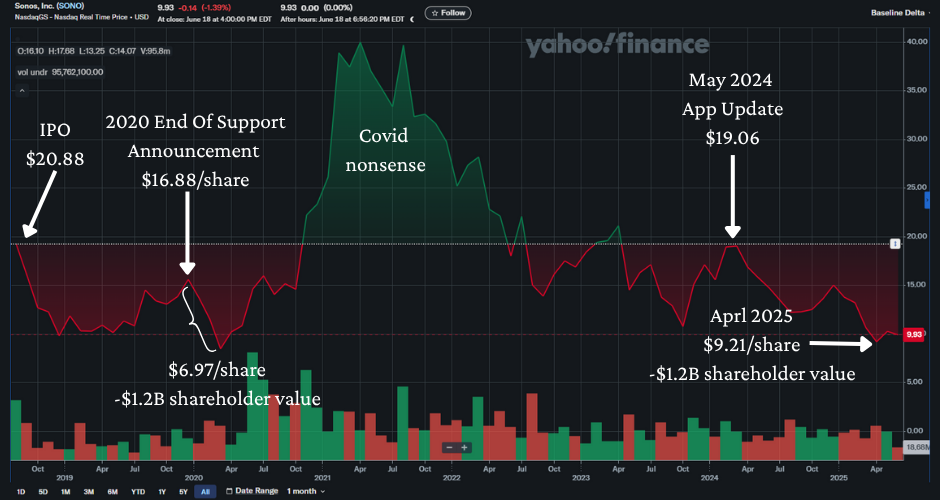
The 2020 end-of-support was announced. It was planned obsolescence.
But when Sonos bricked millions of devices in May 2024, it was unplanned. It was accidental.
It was caused by an important, ambitious, but undertested rearchitecture.
And the crazy thing is — Sonos predicted this problem and the consequences. And they walked into it anyway. Just like Peloton did.
The Sonos case study: a 7-year documented risk
Sonos went public in 2018. In its IPO filing and every annual SEC filing since, they disclosed the following risk:
“We may choose to discontinue support for older versions of our products, resulting in customer dissatisfaction that could negatively affect our business and operating results.”
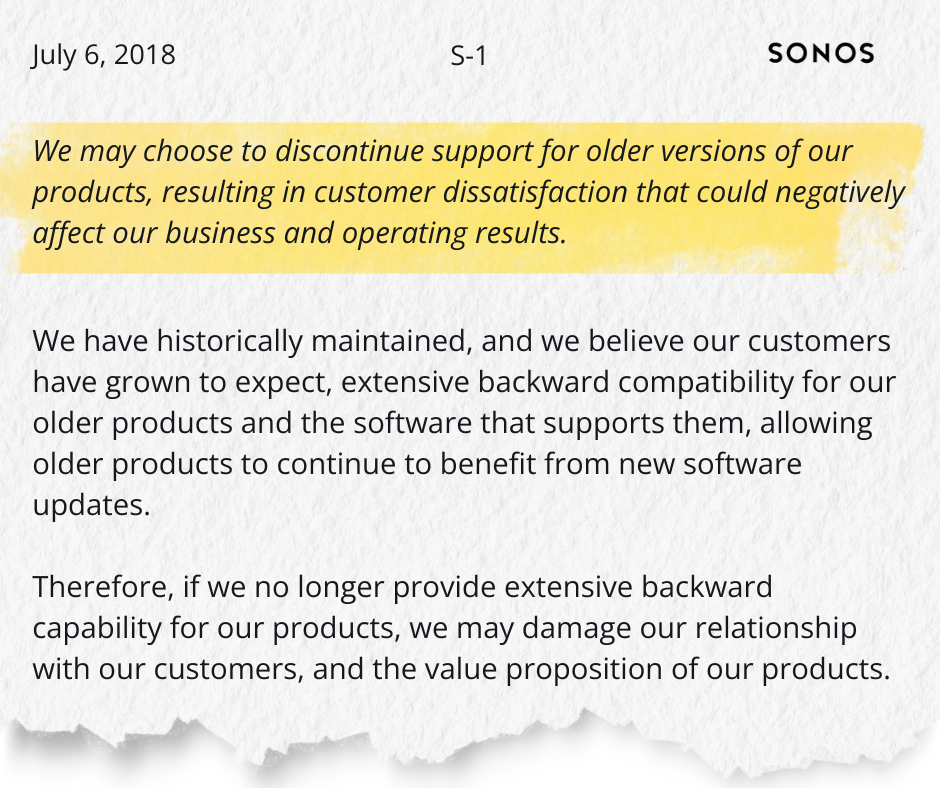
And then they did exactly that — and lost $1.2B of shareholder value!
This wasn’t just a technical failure. It was a management failure — a failure to burn down the risk they saw coming.
They named this risk in every annual SEC filing: 2018, 2019, 2020, 2021, 2022, 2023, and 2024. Seven straight years. Every 10-K.
They weren’t surprised. They were warned — by themselves.
But instead of burning the risk down, they just disclosed it. Like standing on the tracks, watching the train approach, and refusing to move.
And that management failure was preceded by a leadership failure: the failure to set the company’s priorities based on the Infinite Goal.
This is what happens when a company lets a finite goal override its Infinite Goal.
The Sonos case study starts with an infinite goal
Sonos didn’t start out building speakers. They started out chasing a nearly impossible idea.
Here’s how they described it in their S-1 filing under the heading “Where it All Started”:
“In 2002, a handful of engineers and entrepreneurs set out to invent the world’s first wireless, whole-home audio system. At the time, there were no streaming music services. Most U.S. households were still using dial-up. The technical barriers… were so enormous that other companies decided they simply weren’t worth solving. But the team that became Sonos took them on anyway, because they believed that music lovers should be able to play any song, in any room, with great sound and no wires.”
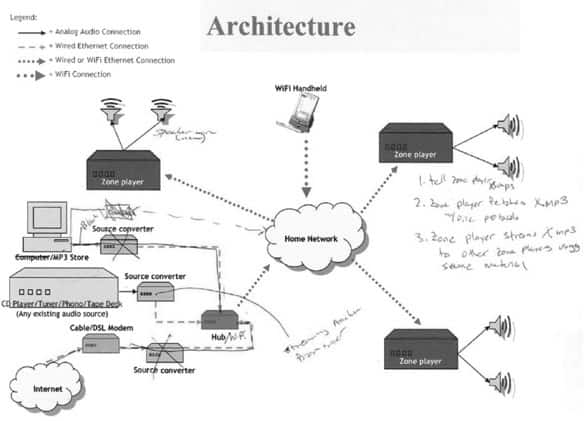
They knew the odds. They knew the constraints. But they were driven, and they pushed themselves to achieve this vision.
They all wanted this product for themselves, and they knew others would want it too.
“Achieving this meant building a software platform that could distribute audio seamlessly across an entire home — without lag, buffering or network interruptions. It all had to work over Wi-Fi. And it all had to be so intuitive and easy that customers would make the system part of their daily lives.”
And they didn’t just solve these problems. They pioneered the solutions:
- Foundational patents in multi-room wireless audio
- One of the first industrial applications of mesh networking
- A product that “just worked” long before Apple made that phrase iconic
They framed their work not as a product roadmap, but as a belief system:
At Sonos, we choose to do the hard things that other companies aren’t willing to do, because even the most difficult problems are worth solving when they make life easier for customers.
That’s not worded as a finite goal. That’s worded as an infinite one. A mission worth building a company around.
Sonos infinite and finite goals
And when they shipped the Sonos Ace headphones, they didn’t just launch a new product — they broke the spell they spent 20 years creating.
Sonos wrote this into their S-1:
Music lovers should be able to play any song, in any room, with great sound and no wires.
The S-1 continued:
“Achieving this meant building a software platform that could distribute audio seamlessly across an entire home — without lag, buffering or network interruptions. It all had to work over Wi-Fi. And it all had to be so intuitive and easy that customers would make the system part of their daily lives.”
That feels pretty compelling to me. But it seems they treated this as a finite goal, a box they checked once they launched and no longer had to maintain.
Because in May 2024, that Infinite Goal was sacrificed for a finite goal: launching the Sonos Ace headphones.

A flashy new product, yes. But one that came at the cost of the seamless, trusted experience that made people fall in love with Sonos in the first place.
The May 2024 update broke trust with Sonos’s most loyal customers.
Sonos didn’t just represent great technology, they earned customer trust. Sonos boasted “As of September 30, 2023, our households own 3.0 products on average.”[4]
A system that worked so well, customers bragged about how much they’d invested.
“Buying into the Sonos ecosystem was the best tech decision I have ever made. Now we have more than 10 Sonos items at home.”
But a vision statement isn’t just for building. It’s for sustaining. And Sonos lost track.
Then May 2024 happened: the Sonos controversy
The update caused widespread failures: no alarm control, missing speakers, broken volume responsiveness, loss of subwoofer control, missing equalizers and app features, bricked integrations.
These weren’t edge-case issues. These were core functions that defined the Sonos experience. The system that prided itself in “just working” was now failing its basic functions.
Professionals who had installed hundreds of systems were suddenly flooded with support calls. Clients demanded refunds. Dealers walked away.
“You people have NO IDEA how bad this update actually is for the end user.”
At the core of this failure was fragility — the kind of fragility that grows when modern architecture is layered over legacy brilliance.
In 2005, when Sonos shipped it’s first product, most homes were on dial-up and didn’t have Wifi. So, to achieve their vision of “listening to music in any room without wires,” they had to build its own wireless mesh network — SonosNet. This was one of the first applications of mesh networking in industry. Sonos devices became mesh nodes before “Mesh” entered the home network protocol in 2011.[7] The result? Perfectly synced, whole-home audio ahead of its time.
“We did not want to rely on the router that was already installed, that’s where the idea for our own wireless network came about. It’s called SonosNet.”
A decade later, Eero, Google Wifi, and Netgear Orbi made mesh wifi ubiquitous in large homes. As Wi-Fi improved, supporting Sonos’s older tech — those ahead-of-their-time solutions like SonosNet — became harder. Yesterday’s brilliance is today’s technical debt. Sonos tried to modernize almost all at once.
The problems introduced by the May 2024 update weren’t just bugs. It was a breach of the trust Sonos had spent 20 years earning.
Why did they push this update at all?
Apple isn’t just a hardware company. Apple is a Software as a Service (SaaS) company. Their photo cataloging service, for example, makes me want to take more pictures. I can tag family members, locations and dates. This makes it easy to create great family moments by pulling up that photo of my wife’s grandmother as a newborn or my 10-year old father with his younger sisters at just the right time.
This makes me want to digitize and categorize old family photos in my iPhone library. That will take up storage space, requiring me to buy iCloud storage. And all of that metadata work? It disappears if I leave the Apple ecosystem.
SaaS is very sticky, it keeps people locked in to products for a long time.
Even Apple TV+, with Apple-produced hits like Severance and The Studio, isn’t just content. It’s a tool to keep you subscribed. It keeps you buying into the Apple ecosystem, while giving Apple predictable cash flow through monthly subscriptions.
Sonos, on the other hand, is a hardware company — a tough line of business.
Unlike Apple and other SaaS companies that generate recurring revenue through subscriptions, hardware companies rely on launching new products to drive growth.
Sonos must use some of that hard-earned revenue to maintain previously sold products to keep their old products compatible with their new ones.
Ford doesn’t have to do that with the cars it sells. The ownership costs rest solely on the consumer, who maintains the vehicle, pays taxes to the government to maintain the roads, and buys gas from another entire industry that drills, refines, and distributes oil products.
But Sonos carries this full burden. If their platform breaks, the speakers break too.
The platform responsibility doesn’t go away. It scales when they sell more products. Sonos is in 16 million homes. If that kit is going to keep working, it is because Sonos is maintaining the infrastructure.
So, to sustain growth, Sonos CEO Patrick Spence set a goal:
Deliver at least 2 new products every year.
In May 2024, the Ace Headphones were that product. But Ace is a leap forward in tech. It has the immersive audio of Dolby Atmos and a tight integration with their home theater system. And Sonos has to maintain it — even as the product line grows older. So to make Ace work, Sonos had to re-architect its entire platform — from the app to the cloud to the firmware on its speakers.
In doing so, they prioritized a finite goal: ship the headphones.
The infinite goal was lost
And they lost sight of the infinite goal, the original promise of seamless integration that built their brand:
“Music lovers should be able to play any song, in any room, with great sound and no wires.”
That vision powered them for decades. Like Apple, Sonos aspired to make everything “just work.” A 2011 Mashable profile even called their setup “a master class in out-of-the-box simplicity.”[9]
Behind the curtain, the system was straining. Speakers were disappearing. Integrations were breaking. The elegant experience that made Sonos magical was now sitting on an aging, increasingly fragile infrastructure.
The dam was already leaking.
And in 2024, it broke.
Complexity explained, but vision abandoned
CEO Patrick Spence later acknowledged the challenge of being in the hardware business and the velocity it requires. But I can see something missing in his statements.
“That is what led to my promise to deliver at least two new products every year — a promise we have successfully delivered on. With the app, however, my push for speed backfired. It’s important to note that this was really a redesign of the entire system — not only the app, but also the player side of our system, as well as our cloud infrastructure — and this was an enormously complex undertaking. As we rolled out the new software to more and more users, it became evident that there were stubborn bugs we had not discovered in our testing.”
He names the deadlines. He names the complexity. But he never names the founding vision which should still live as an infinite goal.
And that’s the real leadership failure.
The CEO’s primary job is to perpetuate the enterprise — not just through execution, but by creating shared purpose aligned on a common goal.
A CEO must be an infinite player, holding the infinite goal, our shared purpose aloft to align all all of the companies resources behind.
To light the lighthouse, especially when the path is foggy.
If the CEO isn’t keeping our eye on the vision, no one else will.
Be an infinite player and look into the future
And the tool for looking into the future?
Risk management.
The failure was foreseeable — and declared, by Sonos, year after year.
Sonos failed to hold their infinite goal in front of them while releasing Ace. They also failed to manage a risk they’ve published in their SEC filings since 2018:
“We may choose to discontinue support for older versions of our products, resulting in customer dissatisfaction that could negatively affect our business and operating results.”
They published this risk for years. They knew that yesterday’s technical brilliance is today’s technical debt.
Every Sonos speaker runs a tiny Linux computer, with embedded software that must evolve as Wi-Fi standards change and new audio codecs emerge. To make the Ace Headphones work — with features like spatial audio that track your head movement while you watch a movie — Sonos had to elevate the technical ceiling of the entire platform.
And that meant rewriting the app from the ground up. An app that supports 50.4 million products in 16 million different households.
These households tend to have a mix of old and new hardware. They have different network configurations. And in many of those households, people’s speakers were disappearing from their systems.
Sonos Chief Innovation Officer Nick Millington explained the technical challenge during a company-run Reddit Q&A:
“The original Sonos app used a wire protocol called SSDP which is based on an IP multicast… We find many networks in which IP multicast is not working… so we provided a parallel (nonstandard) implementation of SSDP over IP broadcast… Our intent [in the new app] was to run both protocols in parallel… We really want to discover your speakers and have them not disappear!”
Nick’s explanation reveals how a legacy protocol layer, one of the brilliant early solutions, had become a systemic risk as home networks evolved.
To really understand how and why this happened, it helps to see SSDP in historical context.
SSDP: the fragile backbone of discovery
For years, Sonos used a protocol called SSDP (Simple Service Discovery Protocol) to help speakers find each other on the network.
SSDP works by using IP multicast to shout across the network:
“Hey everybody! I’m a speaker! I’m here!”
And in 2004, that message was heard loud and clear. The Sonos hardware on the network would find each other and the system would “just work.”
SSDP was designed for simpler, wired home networks — networks with far fewer connected devices than today’s typical setup.
In 2004, most households had a broadband connection with 1 or 2 computers hardwired to a router. In 2024, people have smart TVs, iPhones, iPads, laptops, watches, even cars connecting to the wifi. Wifi 7 is out now with improvements for this broader, less stationary network of things.
But as networks evolved, IP multicast became problematic. It’s been exploited in DDoS attacks where one malicious actor could take control of thousands of infected computers to attack a website. To combat this, many modern routers now block or mishandle multicast traffic altogether. With IP multicast blocked, Sonos devices would fail to find each other and “disappear” from the app.
Sonos patched the problem by pushing SSDP traffic over IP broadcast instead of IP multicast — essentially re-routing the shout down a different hallway. It was clever, but non-standard which made the solution fragile.
The app rewrite was their opportunity to switch to mDNS (Multicast DNS) — a more modern, reliable, OS-supported discovery protocol used by systems like Apple’s Bonjour and Android’s Network Service Discovery. It was a necessary shift, not just a new feature.
So while SSDP once enabled effortless discovery, its reliability crumbled under modern network complexity — making mDNS not optional, but essential.
Addressing this one problem in its own update probably would have gone fine. But they snowplowed this in a massive pile of other technical debt, and the demands of a new product — Ace.
Sonos recognizes this now.
In the wake of the backlash, Sonos Chief Legal Officer Eddie Lazarus was tasked with leading an internal organizational examination to see what went wrong. He shared this insight in an interview with Digital Trends in October 2024:
“We’re not going to roll out another app on an all-or-nothing basis the way we did. We’re going to do things gradually, so that if there are problems, we catch them early and we can make adjustments before we have all our users on the new system.”
Lazarus is indicating a Sonos pivot toward risk management by design.
Burn down the risk over time — create urgency
One of the most important leadership skills is creating urgency before the crisis.
It’s easy to commit to bypass surgery after a heart attack. There’s no ambiguity about the priority then. What’s harder is making time to eat well and exercise when life is busy, results aren’t immediate, and other goals feel more urgent.
That’s what managing technical debt is like. It’s not glamorous. It doesn’t make headlines. The shareholders won’t reward you directly for it, except that your stuff keeps working. It’s proactivity that keeps you out of the operating room.
Leaders must learn to spot accumulating risk — and take action before the pain makes the decision for them.
That’s the power in this risk statement:
“We may choose to discontinue support for older versions of our products, resulting in customer dissatisfaction that could negatively affect our business and operating results.”
In fact, it continues:
“We have historically maintained, and we believe our customers have grown to expect, extensive backward compatibility for our older products… We expect that in the near to intermediate term, this backward compatibility will no longer be practical or cost-effective, and we may decrease or discontinue service for our older products.”
Sonos also boasts that between 37% and 46% of its new product registrations come from existing customers. This backwards compatibility is a double-edged sword. Some of these sales will be people upgrading when their old stuff goes unsupported, some will be growing their base. But customer loyalty is an important trait, and this needs to be maintained with trust.
The obvious next step — treat risk mitigation as work
Risk mitigation is not a bolt-on activity, though many organizations treat it as such. It’s not something you squeeze in after the real work is done. Risk mitigation is work.
Treat your mitigation plans like any other deliverable. Get them in the backlog with everything else — and prioritize them.
Internally, the next step in quantifying Sonos’ risk is clear.
Because every Sonos device is connected to the Sonos Cloud, they have a real-time inventory of the 50.4 million products in the field as of 2024. Sonos knows exactly how many Play:3s are still in use. That knowledge is a luxury. Use it.
They know they have long-standing, loyal customers with mixed setups: old speakers paired with new ones, spread across multiple rooms and generations. That’s not edge-case behavior. That’s real-world behavior.
Design a test setup that reflects that. Treat designing and procuring that test setup as work. Get it in the backlog, and do it.
Eddie Lazarus recognized that, too:
“People have very sophisticated Sonos systems. Some old products, some new products. I think one of the issues for us was we need an even broader set of setups in order to make sure we’re catching all the experience problems ahead of time.”
“Ahead of time.” That’s risk management — seeing into the future.
A future where “Music lovers can play any song, in any room, with great sound and no wires.”
And now, Sonos has built a more robust testing environment — one that mimics the complexity of the majority of 16M actual homes.
And now they have a platform to prove their SSDP solution is fixed for good.
They can treat that, too, as work. Get it in the backlog, and burn it down.
Sonos ran right into the fragility it had created.
And the development culture that once prioritized user experience was no longer intact.
When risk becomes a background process — something to disclose, not manage — companies drift.
But strong leadership keeps moving towards that Infinite Goal like the North Star. Always pursuing, never obtaining. They hold this statement up like a lighthouse in a storm of chaos to give a steady reference point for every bit of work they do.
“Music lovers should be able to play any song, in any room, with great sound and no wires.”
Maintaining this focus on the infinite creates a culture that pursues both the burning down technical debt, and the introduction of Sonos “two new products per year.”
And by doing both, with the infinite goal in mind, Ace won’t demand a full-scale platform rebuilt.
It will just be the next step on a well-tended path.
Conclusion: what the Sonos case study teaches about the infinite goal
The Sonos case study isn’t about a company that stopped innovating. It’s about a company that forgot why it was innovating.
They let the Infinite Goal they were founded on become a slogan on a website instead of their compass, and they lost their way.
In May 2024, Sonos chose a path that broke alignment that with their infinite goal. It let a finite product launch override the trust and experience it had spent decades building.
Companies don’t fail because they take risks. They fail when they forget to assess and properly manage their risk. The pursuit of the Infinite Goal makes the risk worth it — but it also makes the risk management unskippable.
The Sonos controversy of 2024 is a reminder: even the most beloved brands can lose their way when the Infinite Goal fades.
Every company faces this tension. But when the Infinite Goal fades, even the most beloved brands can lose their way.
- [1]Sonos, Inc. “CONNECT Wireless HiFi Player.” Archived December 30, 2011. web.archive.org/web/20111230090825/http://www.sonos.com/shop… ↩
- [2]This language appears consistently from the company's 2018 S-1, and then every 10-K filed with the SEC from 2018 through 2024. See Sonos, Inc., Form S-1 Registration Statement, filed April 23, 2018, 16; see also Sonos, Inc., Form 10-K, fiscal years 2019–2024. investors.sonos.com/reports-and-filings/ ↩
- [3]Sonos, Inc., Form S-1, August 17, 2018. ↩
- [4]Sonos, Inc., Form 10-K, fiscal year 2023. ↩
- [5]qwertyqart, comment on “The Story Behind the Wireless Music System 10 Years in the Making”, YouTube video. www.youtube.com/watch?v=USDkr-dmkDo ↩
- [6]PuzzleheadedWill2257, comment on “The new Sonos app — Feedback Megathread,” Reddit r/sonos, posted ca. 2024. www.reddit.com/r/sonos/comments/1co6iy2/comment/l3hu12q/ ↩
- [7]“IEEE 802.11s,” Wikipedia, last modified May 28, 2024. en.wikipedia.org/wiki/IEEE_802.11s ↩
- [8]Elliot, Amy-Mae. “The Story Behind the Wireless Music System 10 Years in the Making.” Mashable. December 8, 2011. mashable.com/archive/how-sonos-works ↩
- [9]Elliot, Amy-Mae. “The Story Behind the Wireless Music System 10 Years in the Making.” Mashable. December 8, 2011. mashable.com/archive/how-sonos-works ↩
- [10]Patrick Spence, “Sonos (SONO) Q3 2024 Earnings Call Transcript,” The Motley Fool, August 8, 2024. www.fool.com/earnings/call-transcripts/2024/08/08/sonos-sono… ↩
- [11]Nick Millington, comment on “September (2024) Office Hours w/ KeithFromSonos + Nick Millington,” Reddit r/sonos, September 26, 2024. www.reddit.com/r/sonos/comments/1fq1g6n/comment/lp8lwpg/ ↩
- [12]Lazarus, Eddie. “The Sonos Update Interview: We Just Got Taken by Surprise.” Interview by Phil Nickinson, Digital Trends, 2024. www.digitaltrends.com/home-theater/sonos-interview-eddie-laz… ↩
- [13]Lazarus, The Sonos Update Interview. ↩