Principle First:
Performance /pr · for · muhns / noun. The action or process of carrying out or accomplishing an action, task, or function.
We are all imperfect people, just trying to be our best selves every day.
Sometimes our performance doesn’t meet our own expectations. Sometimes the performance of others doesn’t meet our expectations.
Troubleshoot performance issues with this simple tool that will help you get to the root cause.
🧠Today’s Framework: The Skill/Will Matrix
📚Today’s Story: My kids and the pool
📝 Today’s quote
“You miss 100% of the shots you don’t take.” — Wayne Gretzky
🧠The Framework: The Skill/Will Matrix
The “Skill/Will” framework is a powerful coaching tool used to help get to the root cause of performance issues.
We simply look at two key dimensions: skill (competence or ability) and will (motivation or desire).
Once the primary cause of the performance issue is clear, a more targeted coaching strategy can be applied.
Here’s a breakdown of the framework:
1. Skill
This refers to an individual’s knowledge, experience, and technical abilities. When skill is low, the person may lack the necessary competence to perform the task effectively.
Signs of low skill:
- Poor performance despite high effort.
- Frequent mistakes or failure to meet expectations.
- Lack of understanding or knowledge about how to do the job.
- Inability to handle complex tasks.
Coaching Focus:
- Provide training, resources, or mentoring.
- Break tasks into simpler steps or provide guidance.
- Set clear expectations and provide feedback on progress.
- Assure them expertise takes time to develop.
2. Will
This refers to an individual’s motivation, drive, and engagement. When will is low, the person may have the competence but lacks the enthusiasm or commitment to apply their skills.
Signs of low will:
- Lack of initiative or enthusiasm.
- Resistance to taking on new responsibilities.
- Negative attitude or lack of engagement.
- Doing the bare minimum to get by.
Coaching Focus:
- Understand personal goals and motivational drivers.
- Align tasks with individual values or interests.
- Provide recognition and rewards to boost engagement.
- Address potential obstacles or frustrations.
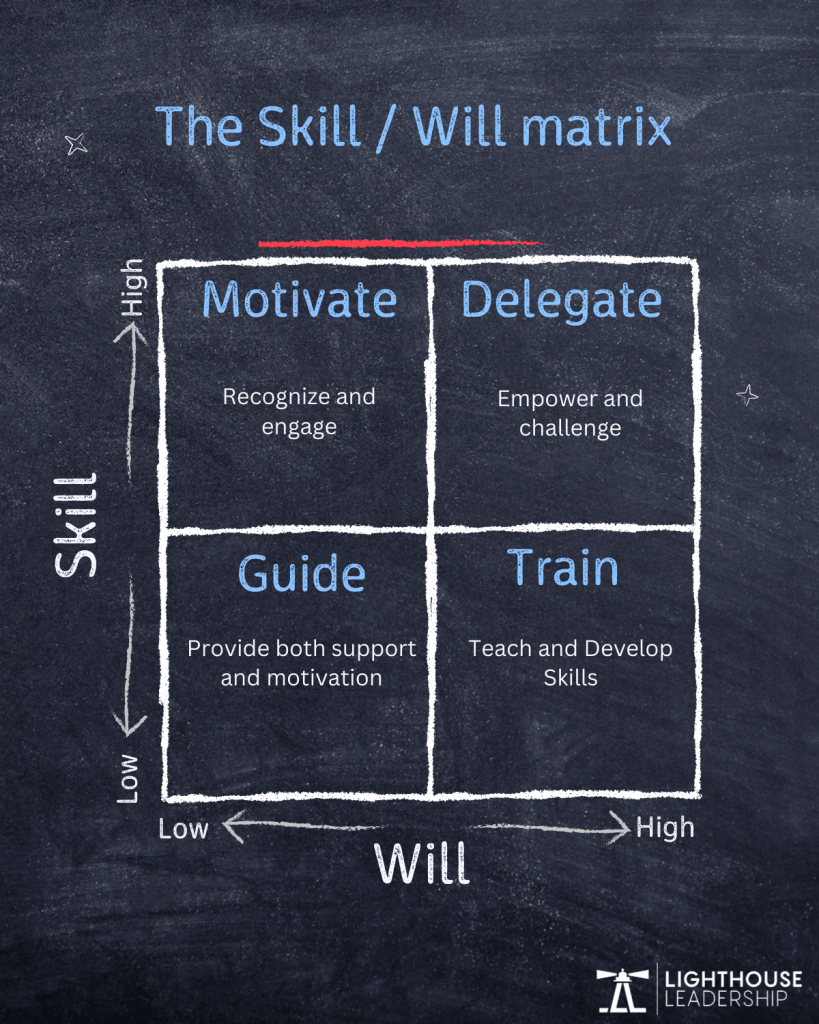
Coaching Strategies for Each Quadrant:
High Skill, High Will (Delegate)
These individuals are self-motivated and competent.
Focus on empowering them by delegating responsibilities and providing opportunities for growth and leadership.
High Skill, Low Will (Motivate)
These individuals are capable but unmotivated.
The coach should focus on reigniting their passion and motivation by recognizing their efforts, connecting tasks to their personal goals, and addressing any frustrations or obstacles.
Low Skill, High Will (Train)
These individuals are eager but need to develop their skills.
The coach should focus on training and development by providing resources, mentorship, and constructive feedback to build their competence.
Low Skill, Low Will (Guide)
These individuals need both skill development and motivation.
The coach must guide them with structured support, training, encouragement, and possibly address any deeper issues (e.g., burnout or mismatched role).
📚The Story: My daughter and the pool
My youngest daughter did not want to go swimming for a couple weeks.
It seemed like she just wasn’t motivated to go.
It seems like a Will issue.
I inquired carefully. She didn’t want to go to the pool because she was not feeling confident in her own skill.
She was in the Low Skill / Low Will quadrant. She needed both skill development and motivation.
She’ll never develop the skill without going to the pool.
So I started by addressing the “Will” barrier in order to create the opportunity to develop the Skill.
We talked about ways to make it fun to get to the pool. We talked about reasons to learn to swim.
A friend of mine had had a young nephew drown in a pool during a party. Everyone was there, and it still happened. It’s a silent killer. He put his kids in two swimming lessons a day for a month and they turned into fish.
I have still not learned how to swim. But I am highly motivated to help my kids learn.
So we started simple. We started getting hot chocolate after swimming. Just a little ritual to help with will. We talked about how fun it is to swim with friends. We talked about how good her older sister is now, and how she got there with practice.
Once the Will barrier was lowered, we recommitted to swimming every Sunday Morning.
We’ve missed the occasional Sunday morning, but we haven’t missed two in a row in months.
And today she was jumping in, submerging her head. Her will is sky high, and her skill is developing!
How will you apply this with your team?
Here are my two favorite coaching references:
HBR’s Guide to Coaching Employees
Coaching for Performance by Sir John Whitmore.
