Principle First:
Feedback /ˈfiːd.bæk /, noun.
1. Engineering: An element of a control system by which information about the output of the state of a system is used to control the input into the system to maintain the desired system behavior. (I.e. a thermostat measures the temperature, compares it the desired temperature, and controls the HVAC system to achieve the desired temperature.)
2. Teams: A process by which information about post or present outcomes is communicated to influence future behaviors of performance.
A thermostat is designed to maintain a room at a set temperature. It continuously monitors the current temperature and compares it to the desired temperature. If the room temperature deviates from the setpoint, the thermostat sends a signal to either increase or decrease the heating or cooling. This process is a loop, where the system receives feedback about the current state and adjusts accordingly to maintain the desired condition.
In a similar way, feedback in our personal and professional lives functions to help us achieve and maintain desired behaviors and performance levels. Just as a thermostat needs accurate information about the room temperature to function correctly, individuals need honest and precise feedback to understand how their actions align with their goals and expectations.
As a manager, you’ll be delegating to your team. And your delegation may even be something large like a project. This delegation should be coupled with feedback to help the team deliver the results you intended.
🧠Today’s Frameworks: Mindset, Feedback, and The Johari Window
📚Today’s Story: Michael Jordan’s amazing turnaround from failure to legend
📚The Story: Michael Jordan
Michael Jordan is largely considered to be the greatest basketball player of all time. The trophy given by the National Basketball Association to their Most Valuable Player is called the “Michael Jordan Trophy”.
But when he was 15, he was cut from his high school team.
What facilitated this turnaround?
He received specific, relevant feedback on what he needed to improve.
He told he wasn’t good enough at defense, ball handling, or shooting to make his high school team.
Look at what he achieved in a few short years:
- When he was 21 he won Gold at the Olympics.
- When he was 22 he was NBA Rookie of the Year.
- When he was 24 he was NBA Defensive Player of the Year.
- When he was 25 he was NBA Scoring Champion of the Year.
He used this feedback to focus his development efforts. He worked very hard in these three particular areas.
Look at this again.
From not good enough at defense to Defensive Player of the Year.
From not good enough at shooting to Scoring Champion of the Year.
From not good enough at ball handling to this:

He went from the worst to the best because specific, relevant feedback informed his development agenda.
I’m going to describe three short frameworks to help you do the same – Mindset, Feedback, and the Johari Window.
In about 6 minutes you’ll have a script tying all these concepts together to help you get started.
 The Framework: Mindset
Carol Dweck’s book Mindset is required reading when you become a manager at Google.
- 𝗧𝗵𝗲𝗿𝗲 𝗮𝗿𝗲 𝘁𝘄𝗼 𝘁𝘆𝗽𝗲𝘀 𝗼𝗳 𝗺𝗶𝗻𝗱𝘀𝗲𝘁𝘀: – Growth Mindset – Fixed Mindset
The hallmark of a Fixed Mindset is a belief you skills are set in stone. So there is no point in trying to improve. When you fail in a Fixed Mindset you say “I’m not good at…”
The hallmark of a Growth Mindset is the belief that your skills can be developed through your own efforts.
So when you fail in a Growth Mindset you say “here is an opportunity to learn.”
- 𝗧𝗵𝗲 𝘀𝗮𝗺𝗲 𝗽𝗲𝗿𝘀𝗼𝗻 𝗰𝗮𝗻 𝗵𝗮𝘃𝗲 𝗱𝗶𝗳𝗳𝗲𝗿𝗲𝗻𝘁 𝗺𝗶𝗻𝗱𝘀𝗲𝘁𝘀 𝗶𝗻 𝗱𝗶𝗳𝗳𝗲𝗿𝗲𝗻𝘁 𝘁𝗼𝗽𝗶𝗰𝘀.
- 𝗬𝗼𝘂 𝗰𝗮𝗻 𝗰𝗵𝗮𝗻𝗴𝗲 𝘆𝗼𝘂𝗿 𝗺𝗶𝗻𝗱𝘀𝗲𝘁.
She uses Michael Jordan as an example of a “Growth Mindset.”
The Mindset concept is important not only for our own development, but for the development of our team.
Humility is a key value in a Growth Mindset. As a manager you can cultivate and exhibit a Growth Mindset in several ways:
- Remain open and ask for feedback often.
- Share personal stories of mistakes and failure.
- Say, “I don’t know.”
 Tip: Practice these ideas this week. By setting this example, you’ll start to soften the fixed mindsets on your team and amongst your peers. And that will create an environment conducive to learning through feedback.
🧠The Feedback Framework: SBI, Situation, Behavior, Impact
Michael Jordan was able to develop himself in the gym and get real time feedback. Take a shot – success means it goes in the basket, failure means it doesn’t. The feedback is quick. This fast feedback leads to quick learning.
We rarely have such clear pass/fail criteria in business. We need feedback from external sources to help us understand what’s working and what isn’t.
A great manager is a coach. And a coach gives both positive (motivational) feedback and negative (developmental) feedback.
The same framework can be used for both motivational and developmental feedback:
S, B, I
Situation you want to discuss
Behavior in the situation
Impact on others of that behavior
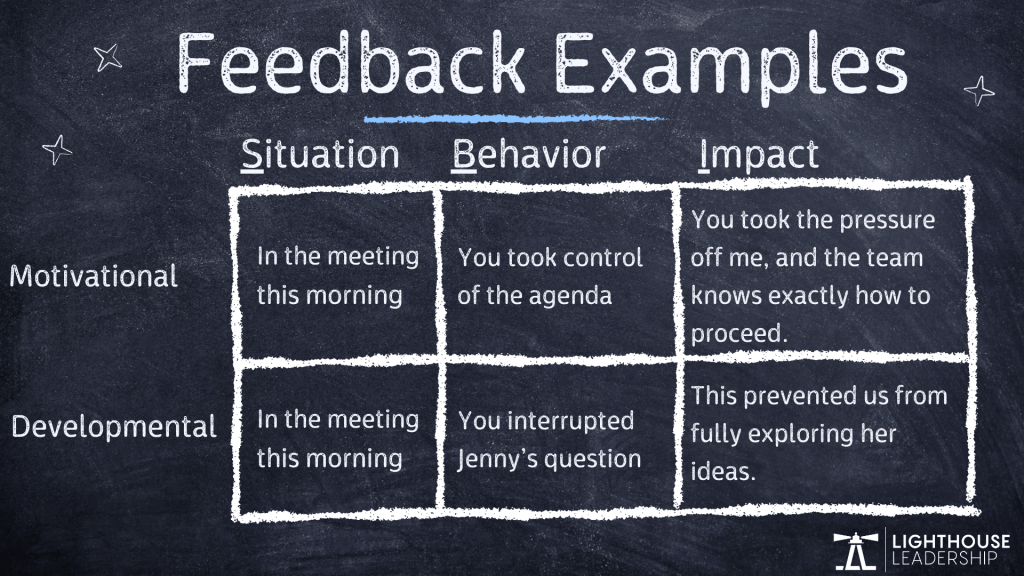
As in Negotiation, it’s imperative we separate the person from the issue, and address the issue.
Think of these definitions:
Shame: I am something wrong.
Guilt: I did something wrong.
If we shame people by attacking them personally, they’ll shut down. It puts someone into a Fixed Mindset. We want to address the action. That helps put someone into a Growth Mindset.
Here is a 2 minute video illustrating S.B.I. feedback.
TIP: Your feedback will be well received when well-phrased, and when the employee trusts you, believes you care about them as a person, and that you and they are aligned on a common goal.
🧠The Johari Window: Why we need to give feedback
The Johari Window was created by Joseph Luft and Harrington Ingham. It illustrates the importance of giving and receiving feedback.
The model divides self-awareness into four quadrants: Public Self, Private Self, Unknown, and the Blindspot.

It is harder to see our own strengths and weaknesses than it is to see the strengths and weaknesses of others.
That is why feedback is so essential to give and to receive.
By shedding light on people’s blindspots, we improve their self-awareness. This self-awareness enables them to double down on their strengths and develop their weaknesses.
It was easy to see that Michael Jordan didn’t make the basketball team. But his coach took the time to also describe the Why.
The specific feedback he received – ball handling, shooting, defense – shed light on his blindspot. He took that specific knowledge of his weaknesses, practiced in those same areas, and turned those weaknesses into strengths.
I have received feedback from many that my communication is very good. But just a few years ago, I received feedback that my communication was lagging behind my other skills.
This transformation is not magic. I started writing every day. That deliberate practice, initiated because of the feedback I received, has resulted in the improvement.
📃A script for getting started
You don’t want to fail.
Let’s assume the other person doesn’t want to fail either. So start with the belief they WANT the feedback you have to offer.
This means you adopt the belief that they have a Growth Mindset.
Exhibiting a Growth Mindset yourself will be infectious to them. You are exhibiting a Growth Mindset by practicing your feedback skills in public.
Start by describing the goal you share:
- “We both want this XYZ to succeed. Let’s make sure it does, and improve ourselves at the same time.”
- “I’ve just learned about this thing called the Johari Window.”(Explain it. Send them this newsletter.)
- “I’m interested in what you know about my blindspot, and I’d like feedback from you.”
- “I have a feedback framework I’d like to start using. Can I start by giving you some feedback to illustrate how this works?”
- “I’m still learning this; please understand I mean the best for you and for this project. And I’m interested in your feedback on my feedback.”
- Situation – Behavior – Impact
- “Now, can you give me some feedback? I know this may feel awkward at first. I promise I won’t take it personally even if you haven’t structured this feedback perfectly. For instance, how did this feedback conversation work for you?”
SBI describes what happened, but it does not complete the Coaching conversation which should result in some actions. I’ll build on this idea next week where we add in discussion, option co-creation, and next steps.
I’m also building out some prompts to help you formulate your feedback conversation with the help of ChatGPT.

7 thoughts on “Empower Your Team: A Proven Feedback Framework For High Performance”