Principle first:
Vulnerable /vuhl · nuh · ruh · bl/ adjective. Capable of being physically or emotionally wounded.
Vulnerability sounds like description of weakness. But it’s the stuff teams are made of.
If trust is a cornerstone of a great team, vulnerability is the bedrock upon which that trust is built.
When trust increases in a team, so does speed.
I didn’t always appreciate this, and I’ll describe a recent miss that I’ve learned from so you can learn too.
🧠Today’s Framework: Vulnerability Loop
📚Today’s Story: My recent miss
📝Today’s Quote:
“Vulnerability is not weakness, and the uncertainty, risk, and emotional exposure we face every day are not optional.
Our only choice is a question of engagement.
Our willingness to own and engage with our vulnerability determines the depth of our courage and the clarity of our purpose; the level to which we protect ourselves from being vulnerable is a measure of our fear and disconnection.”
– Brené Brown, Daring Greatly
🧠Framework: Vulnerability Loop
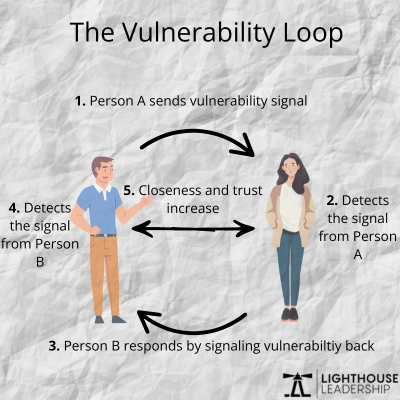
Daniel Coyle, author of The Culture Code, describes the following framework he calls a “Vulnerability Loop”. Here’s how it works:
1. Person A signals vulnerability.
2. The signal is received by Person B.
3. Person B reciprocates by signaling vulnerability in return.
4. The signal is received by Person A.
5. The loop is closed. Person A and Person B are closer.
It takes vulnerability to say “I don’t know” or “I made a mistake.” This makes vulnerability a key factor in team learning and growth.
One of the most powerful concepts in the After Action Review is they encourage everyone to openly reflect on what they could have done better as individuals for a better team outcome. But if the vulnerability is not reciprocated or punished – psychological safety is shattered, and the sharing will stop.
When the vulnerability is accepted, people grow closer and trust deepens.
When the vulnerability is punished, ignored, or dismissed, a fracture will form.
Not reciprocating vulnerability is always a missed opportunity.
Here’s a recent opportunity where I failed to close the vulnerability loop.
📚Today’s Story: My recent miss
I was facilitating a weekly team meeting. We always begin by spending the first 5 minutes of the meeting building our agenda and then we walk through the topics one by one.
About half way through the meeting, someone interjected: “Today is my father’s birthday.”
It wasn’t on the agenda, and I couldn’t immediately see its relevance. The room went quiet. Nobody responded. After a few seconds, we moved on.
What I didn’t realize at the time was that this interjection was deeply significant.
The team member who spoke had unique knowledge of the topic we were discussing. A year earlier, while working on this project at a different location, they had received a call that their father had been diagnosed with cancer.
The connection between the team topic and this personal event was private, but it clearly weighed heavily on them. They shared a piece of vulnerability, and I missed it.
By not recognizing the vulnerability signal, I missed an opportunity to build trust and help this team member process the overlap between work and personal experience. Worse, we lost the chance to convert his individual knowledge into valuable team insight.
Here’s how I could have closed this vulnerability loop:
Team Member:
“Today is my father’s birthday.”
Me:
(Pausing to acknowledge) “Wonderful – I wish your dad a Happy Birthday. I imagine your father’s birthday brings up some memories for you.”
(Giving space for them to expand on the emotional connection)
Team Member:
“Yeah, it was around this time last year when I was at the other location. We were working on this same aspect of the project. That’s when I got the news about my dad’s cancer.”
Me:
(Connecting the dots) “That must have been an incredibly difficult time for you. I can see how this topic is bringing up some of those memories. Do you think there’s something from that experience—personal or work-related—that could help us with what we’re facing here?”
Team Member:
“Honestly, yeah. When I was working on that last project, I wasn’t fully present because of everything happening with my dad. I couldn’t quite implement what I thought needed to happen. But, a year later, I’m seeing some of the same challenges here, and I think I have some ideas of what can be done differently.”
Me:
(Encouraging reflection and sharing) “I’m really glad you shared that. What insights do you have now that might help us avoid the same pitfalls? How can we support you in applying that experience?”
By asking these questions and showing genuine interest, I would have acknowledged the emotional weight of the situation and created space for the team member to share their unique perspective. This would have allowed the team to gain valuable insight from his prior experience and deepen the cohesion between team members.
Key Takeaways:
- Acknowledge Emotion, Ask Questions: Recognize the significance behind someone’s vulnerability. Instead of just acknowledging it, ask follow-up questions that show you care and invite further reflection.
- Connect Personal and Professional: Help the team member process how their personal experience connects with the project at hand. This fosters trust and converts personal challenges into team learning.
- Give Space for Deeper Sharing: Sometimes a simple acknowledgment isn’t enough. Giving the other person space to expand on their feelings opens the door to greater insights and builds a culture of openness.
📕1 Book, 🎧 1 Podcast, 📺1 Video, 📰1 Article
Here’s the best stuff I’ve found while researching this.
📕Today’s Book:
This book explores the role of vulnerability in leadership and offers practical strategies for creating trusting and courageous teams.
“Dare to Lead” by Brené Brown
🎧Today’s Podcast:
Charles Feltman illuminates the four distinctions of Trust that comprises his framework, working with Leaders, Teams and Individuals.
The episode discusses how trust is eroded, the many strategies that are deployed on teams and in organisations when trust is absent and how to rebuild trust effectively.
The Game of Teams – Episode 68 “The Thin Book of Trust with Charles Feltman” (or on Apple Podcasts). (61 minutes)
📺Today’s Video:
This TED Talk explains how vulnerability strengthens relationships and is essential for building trust, both personally and professionally.
This used to be niche, but now it’s got 23M views on YouTube and 66M views on TED.
“Brené Brown: The Power of Vulnerability” TED (20 minutes)
📰Today’s Article:
This article provides insights into how vulnerability can be used to strengthen teams, enhance collaboration, and foster psychological safety.
“The Best Leaders Aren’t Afraid to be Vulnerable” by Janice Omadeke, Harvard Business Review.

2 thoughts on “Building Trust Through Vulnerability in Teams”