
How to take the long view in business: the Jiminy Peak forever goal
What fifty years of one ski-resort owner’s decisions teach about how to take the long view in business — and what Sonos forgot when it didn’t.
“I don’t understand. You want to go into the utility business?”
Brian Fairbank wasn’t starting a power utility. He was trying to save Jiminy Peak, the Western Massachusetts ski resort he had owned for twenty years. And he needed a $4 million loan.
What follows is a story about why a 59-year-old ski-resort owner asked his bank for $4 million to put a wind turbine on top of a mountain — and what it teaches about how to take the long view in business, and the goals you should and shouldn’t write down.
Fairbank had been addicted to skiing since he was six, when his father took him to a little rope-tow area called Emery Park near Buffalo. He spent the day crashing. He was hooked by sundown.
But the moment that probably mattered most happened when he was twelve. His parents took him camping at Whiteface Mountain. He sat mesmerized by the lifts. A man named Arthur Draper, who turned out to be the general manager, started chatting with him. Brian asked what it was like to build a ski area. Draper gave this precocious twelve-year-old an overview. When Brian got home, he sent Draper a topographical map of a local hill he was thinking about developing. Draper replied with a two-page letter about wind, slope design, and where to put the lifts.
Fairbank called that “magical”[1] in fueling his passion for the ski industry. Fifty years later, you can see what kind of man it made.
He looked across the table at his banker. He could understand the skepticism. In 2006, nobody in North America had ever put a wind turbine on top of a ski mountain, let alone one that could power 600 homes. But Brian knew exactly why he was doing this.
It had to do with the electricity bill.
Why the turbine was the long view
Running a ski resort is a tough business. You spend all year maintaining lifts, trails, and grooming machinery to make your money in the six weeks between Christmas and Presidents’ Day. Few understand this better than Brian Fairbank, who has owned Jiminy Peak since 1985. When he started working there in 1969, they had four employees and two buildings. Now they have lodging for 3,000 guests. His leadership has earned him a spot in the National Ski and Snowboard Hall of Fame and a Lifetime Achievement Award from the National Ski Areas Association.
In 1974, just five years after Fairbank arrived, Jiminy nearly went bankrupt. If it had, it would have joined more than 170 shuttered ski areas in the northeast. This is a tough business and the weather that year made it tougher.
“Maybe you got enough snow to ski off one or two lifts for a week or two. That was the closest we ever came to bankruptcy. I got some job offers, one of them from Loon Mountain. Governor Sherman Adams called me at six in the morning on the Fourth of July and said, ‘Are you coming up to work here or not? I’m not getting off the phone until I have an answer.’ I said, ‘Governor, I guess my answer has to be no.’ That left me in the situation of how am I going to resurrect Jiminy?”
He spent the next decade watching dozens of areas close. He noticed one thing: the mountains that made their own snow had the best chance of survival. You had to cheat Mother Nature to live.
Making snow takes three things — water, air, and energy. A snow gun mixes high-pressure air with reservoir water to make tiny droplets that freeze before they hit the ground. You still need cold temperatures, but you no longer need her precipitation. You do, however, need a tremendous amount of water and electricity. Jiminy converts nearly 90 million gallons of water — about 130 Olympic-sized swimming pools — into snow between Thanksgiving and Christmas to get the 170-acre mountain open for the money-making period.[3]
By the early 2000s, escalations in energy costs had raised Jiminy Peak’s annual power bill to half a million dollars a year.[4] That wasn’t a side expense. That was a threat to the mountain’s survival.
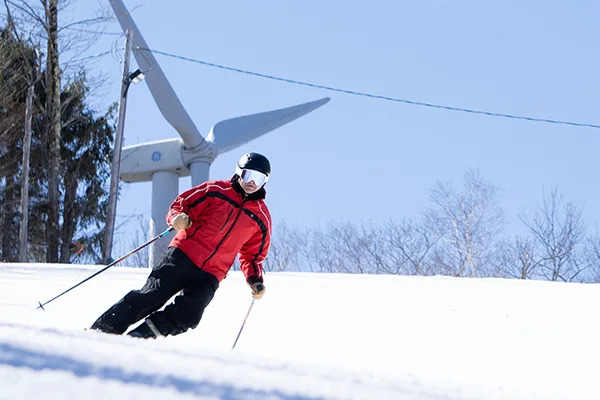
A wind turbine capable of generating enough electricity to power 600 homes[5] didn’t mean Brian was setting up a utility — he was offsetting a significant chunk of this energy cost permanently. The banker agreed. The project was funded.
The investment paid for itself in seven years.
A surprise sustainability moniker
CNN called it a sustainability story. The National Ski Areas Association gave Jiminy the Golden Eagle Award for environmental excellence. Brian accepted the credit. But he was clear-eyed about what had actually happened. The mountain needed to cut its energy costs.
Brian’s son Tyler — who left the family business at twenty-nine to prove himself on his own terms, spent a decade in other industries, and returned through the side door of renewable energy to eventually run the Fairbank Group — gives the cleanest articulation of what the long view actually means in practice.[6]
“Take the long view. We didn’t make decisions about next quarter or even next season or next year. It was 5, 10, 20 years out — what is the right thing to do?”
The long view doesn’t mean ignoring financial reality. It means letting a long-range purpose govern which financial realities you pursue. Where the math aligned with the mission, they moved. Where it didn’t, they waited.
The math worked in Massachusetts, where state renewable energy credits made the project financeable. In New Hampshire, where those credits didn’t exist, the Fairbanks’ other mountain — Cranmore — has no turbine. Same family. Same values. Different incentive structure. “It didn’t pencil out.” No turbine.[8]
This is not a contradiction. It’s the point.
The pattern
The turbine was not a one-off gamble. It was one answer to a question the Fairbanks had consistently asked for decades: how can we save money by conserving energy?
They had a dozen other answers. They installed LED lighting. When they needed to heat a new lodge, instead of installing a traditional fossil-fuel furnace they installed a co-generation plant — burning propane to make electricity for the lodge, with the waste energy heating the building. Two birds, one stone. They captured waste heat from snowmaking compressors to warm the lodge. They run a lot of machinery and use a lot of motor oil; they burn that used motor oil to heat the operations building. Brian installed that system in 1986, well before green was a marketing category. All of this serves the ski operation while reducing cost.
Then there was the snow gun. Chasing the same logic — stabilize snowmaking costs, protect the business — the Fairbanks developed a new snow-gun technology that cut their snowmaking energy in half while nearly doubling the snow output. A four-times efficiency gain.[9] They now sell that technology to other mountains.
And they installed waterless urinals that save nearly 500,000 gallons of water annually[10] — enough to put a foot of snow on three acres of trail. Water conserved in the bathroom is water available for snowmaking. Water available for snowmaking protects lift-ticket revenue. Lift-ticket revenue protects the mountain.
At Jiminy Peak, even the toilets serve the system.
The name was already true Brian Fairbank didn’t start with a philosophy. He started with survival. But across five decades of decisions — each one made under real pressure, each one pointing the same direction — the philosophy became visible. And once it was visible, he expressed it. To his team. To other mountain operators. Eventually, to anyone who found their sustainability page:
“Jiminy strongly believes in preserving the earth for future generations.”
This is what I call a forever goal. You never fully arrive. You are always moving toward it. And that’s precisely what makes it useful — because it governs decisions not just at the level of the turbine, but at the level of the toilet.
Jiminy Peak did not write their goal down first. They just kept making the same decision, in the same direction, for fifty years. When they finally named it, the name was already true. And then they wrote it down. Because writing it down — even after the fact — is what lets a forever goal govern when you are not in the room.
What Sonos forgot
Sonos wrote their forever goal down in 2002 — “music lovers should be able to play any song, in any room, with great sound and no wires” — and for two decades it governed. Then they launched Ace, a headphone, and rewrote the software platform that connected every Sonos device in every room to make it possible. The rewrite broke the system that “no wires” had promised to sustain, for the 50 million devices already in customers’ homes. (I wrote about that collapse in detail here.)
Nobody at Sonos asked, on the night they shipped Ace, whether the launch served the founding purpose. They were asking whether the launch was ready.
They did not stop executing. They stopped anchoring.
Finite and infinite
James P. Carse wrote that there are two kinds of games. A finite game is played to win. It has a beginning, an end, and a winner. You complete it and move on. An infinite game is played to continue the play. It has no finish line. You do not win it. You sustain it.
Both exist inside every organization. Finite goals are projects. You scope them, execute them, and close them out. Infinite purpose is different in kind, not just in scale. It is not a larger project or a longer deadline. It answers a different question entirely: not what are we building but who are we, and what must remain true as everything else changes. You do not complete it. You either hold it or you don’t.
Carse identified the structural rule that governs how these two relate:
“Finite games can be played within an infinite game, but an infinite game cannot be played within a finite game.”
This is not merely philosophical. It is operational. Finite goals must be subservient to infinite purpose — evaluated against it, constrained by it, discarded when they betray it. The moment a finite goal rises above the infinite purpose it was meant to serve, the organization begins to drift. Not because execution fails, but because execution is detached from the intended direction.
Jiminy Peak held the structure correctly. Every decision Brian and Tyler Fairbank made — the turbine, the snowmaking upgrades, the cogeneration plant, the waterless urinals, the Cranmore turbine they didn’t build — was a finite project evaluated against a stable infinite purpose: preserve the mountain for future generations. The infinite purpose didn’t just generate ideas. It governed which finite goals were worth pursuing.
Sonos launched Ace. They forgot to ask the question the Fairbanks never stopped asking.
The difference is not who had the better statement.
The difference is who let the goal govern.
So take the long view of your own
Look at the last five decisions your team actually made. Not the ones in the strategy deck. The decisions someone made on a Tuesday afternoon, under pressure, when no one was watching.
Did your forever goal govern them? Or did it sit on the About page while the decisions happened somewhere else?
If the honest answer is no — or “I’m not even sure what our forever goal is” — that is the work. Not the writing of the statement. The naming of the direction your team has already been moving, and then letting it govern from there.
I wrote a playbook for that. Nine steps, from the first conversations to a forever goal that governs decisions you never anticipated. It’s free.
Brian got away with not writing it down. Most of us can’t, and shouldn’t try. Writing the forever goal down sharpens it, scales it, and lets it govern when you are not in the room. The playbook is for that.
- [1]Stuart Winchester, host, Fairbank Group (Jiminy Peak, Cranmore, Bromley) Chairman Brian Fairbank, Episode 26, The Storm Skiing Journal and Podcast, October 2020, 1h 21m. stormskiing.com/p/podcast-26-fairbank-group-jiminy ↩
- [2]Brian’s biography is discussed at length in this hour-long podcast with Stuart Winchester. Stuart Winchester, host, Fairbank Group (Jiminy Peak, Cranmore, Bromley) Chairman Brian Fairbank, Episode 26, The Storm Skiing Journal and Podcast, October 2020, 1h 21m. stormskiing.com/p/podcast-26-fairbank-group-jiminy ↩
- [3]Jiminy Peak’s sustainability page reports that it takes 180,000 gallons of water to make an acre-foot of snow. “Jiminy Peak Sustainability,” Jiminy Peak, accessed January 21, 2024, jiminypeak.com/the-mountain/mountain-information/sustainability. Acreage from Avalon Gulley et al., Beyond The Turbine: Initiatives for a Sustainable Jiminy Peak (n.d.), accessed January 26, 2024, web.williams.edu/wp-etc/ces/jiminy-peak.pdf. The Snowgun Technologies marketing page reports 87 million gallons used in 2016. ↩
- [4]Andy Bigford, “Brian Fairbank — Hall of Fame Class 2020,” U.S. Ski & Snowboard Hall of Fame, 2020. skihall.com/hall-of-famers/brian-fairbank ↩
- [5]Ayesha Tejpar, “Wind Power Helps Ski Resort during Recession,” CNN.com, February 27, 2009. cnn.com/2009/TECH/02/27/ski.wind.turbine ↩
- [6]Stuart Winchester, host, Jiminy Peak GM & Fairbank Group CEO Tyler Fairbank, Episode 202, The Storm Skiing Journal and Podcast, April 7, 2025, 1h 21m. stormskiing.com/p/podcast-202-jiminy-peak-gm-and-fairbank ↩
- [7]Stuart Winchester, host, Jiminy Peak GM & Fairbank Group CEO Tyler Fairbank, Episode 202, The Storm Skiing Journal and Podcast, April 7, 2025, 1h 21m, at 11:54. stormskiing.com/p/podcast-202-jiminy-peak-gm-and-fairbank ↩
- [8]Stuart Winchester, host, Fairbank Group (Jiminy Peak, Cranmore, Bromley) Chairman Brian Fairbank, Episode 26, The Storm Skiing Journal and Podcast, October 2020, 1h 21m. stormskiing.com/p/podcast-26-fairbank-group-jiminy ↩
- [9]“Snowgun Technologies — Setting New Standards for Performance in the Snowgun Industry.” Snowgun Technologies, accessed December 20, 2024. snowguntech.com ↩
- [10]“Jiminy Peak Sustainability,” Jiminy Peak, accessed January 21, 2024. jiminypeak.com/the-mountain/mountain-information/sustainability ↩
- [11]“Jiminy Peak Sustainability,” Jiminy Peak, accessed January 21, 2024. jiminypeak.com/the-mountain/mountain-information/sustainability ↩
- [12]James P. Carse, Finite and Infinite Games: A Vision of Life as Play and Possibility (Free Press, 1986), p. 7. ↩
Further reading
For the full Sonos story — how a 22-year-old forever goal got out-prioritized by a headphone launch — see The Sonos Collapse: How Leadership Drift and Ignoring Risk Ruined a Great Brand.