Principle First:
Framework /fraym-wurk/ noun.
1. An essential supporting structure of a building, vehicle, or object.
2. A basic structure underlying a system, concept, or text.
🧠 Today’s Framework: Frameworks (meta much?)
📚Today’s Story: My Awakening to Frameworks
📝 Today’s Quotes:
From complexity comes stress, anxiety, frustration.
The human brain tries its hardest to simplify life by setting up routine patterns of perception and of action.
One you identify the pattern you flow along it without further effort.
- Edward De Bono, Simplicity p 18
You can’t really know anything if you just remember isolated facts and try and bang ’em back.
If the facts don’t hang together on a latticework of theory, you don’t have them in a useable form.
- Charlie Munger
Frameworks help us simplify life.
I’ll tell the story of when that clicked for me.
📚 The Story: My Awakening to Frameworks
I’ve learned you can’t transform without hitting rock bottom.
Here’s my rock bottom.
I was overwhelmed.
I had 160 people looking to me for guidance. I felt like I was drowning in a sea of solvable problems but couldn’t find a way out.
Every day, I ran out of daylight, while my team sat idle. I was doing their job instead of mine. I knew how to do their job. I didn’t know how to do mine.
The pressure was immense, and I was paralyzed, unsure of how to lead or even where to start. I knew I had to change something, but every move I made seemed to sink me deeper into the hole.
Just when I thought I couldn’t go any lower, a lifeline appeared. Her name was Jane. Jane saw something in me that I couldn’t see in myself.
She was the advisor of a group tasked with defining a culture of sustained success. I had been nominated to that team by my boss and boss’s boss.
Our eventual findings? Leadership is the differentiator. So, we should:
- Define a leadership standard.
- Select leaders based on this standard.
- Develop people’s understanding of this standard through training and coaching.
- Hold people accountable for living this standard.
When we wrote that, I was finally was out of the hole. But when I was in the hole, I didn’t know what any of this meant.
Back to the hole.
We were a small group—about eight of us—gathered in a conference room 320 miles from my home. It felt like a world away from the chaos I left behind.
Jane sat next to me and handed each of us a book titled Mastering Leadership. “This is our leadership manual,” she said. As I opened the book, something shifted inside me. I started reading and took twenty pages of notes in the first seven pages alone. The words resonated deeply.
“Set direction and create meaningful work,” it said.
That was it. That was the phrase I needed to shift these solvable problems off my desk and into the team. It took a year, but I finally created alignment behind a vision statement, defined the work, an built a team structure to execute it.
Back in the hole – for a week, we delved into the intricacies of leadership. We discussed how leadership could be a game-changer, the true differentiator between businesses and teams.
I heard someone say, “We need to develop a framework.”
I had no idea what he was talking about.
For a day and a half, the group debated the concept of frameworks while I sat there, completely lost. Finally, I couldn’t take it anymore.
“What’s a framework?” I blurted out.
The room fell silent, and I felt every eye turn toward me, their gazes filled with disbelief. How could I have missed something we’d been discussing for hours?
But that question became my turning point. They recapped the last day and a half for me.
Instead of sinking back into self-doubt, I listened intently as they explained. They introduced us to a leadership framework from the United States Air Force’s Center for Character and Leadership Development. And for the first time, I saw the path forward. I understood how to structure leadership principles in a way that was actionable and clear.
I struggled managing the complexity of my life. Until the power of the framework clicked.
I was drowning in complexity, until I learned how frameworks can help.
A framework simplifies life by providing a clear structure and guiding principles, breaking down overwhelming tasks into manageable steps, and organizing a sea of information to highlight what’s most important.
Six months later, something remarkable happened.
Despite being the one who seemed out of his depth just months before, I was invited to co-author the first leadership framework for our $4.5B company. I had gone from feeling like the last person who should be in that room to becoming a leader who helped shape the very principles we were there to define.
I had climbed out of the hole, not just back to where I was before, but to a higher place I never imagined I could reach.
And I carry dozens and dozens of frameworks with me everywhere I go.
🧠 On Frameworks
A framework is a structured approach or set of guidelines designed to help analyze, understand, or solve a problem.
Frameworks provide a systematic way to break down complex issues into more manageable parts.
They are often used across various fields such as business, psychology, education, and science to help structure thinking, decision-making, and problem-solving processes.
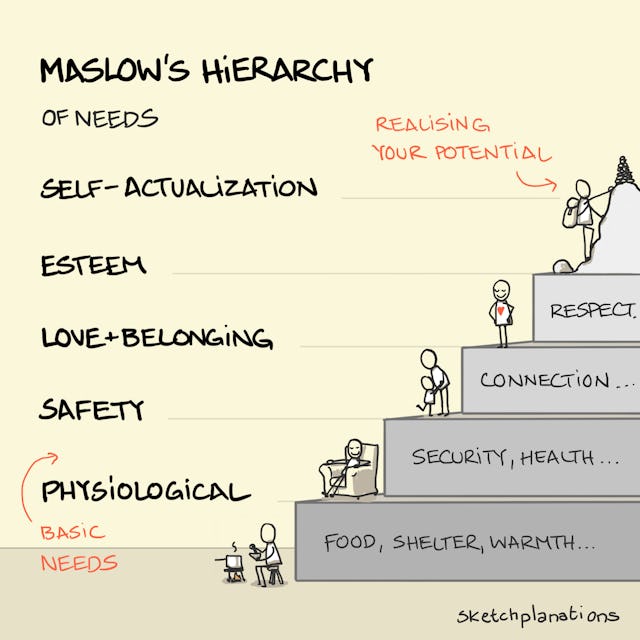
One of the most famous frameworks is Maslow’s Hiearchy of Needs. It’s visual nature makes it more memorable.
Yuval Noah Harari starts his book Sapiens with a bang. And a framework of time and science in one.
“About 13.5 Billion years ago, matter, energy, time and space came into being in what is known as the Big Bang. The story of these fundamental features is called physics.
About 300,000 years after their appearance, matter and energy started to coalesce into complex structures, called atoms, which then combined into molecules. The story of atoms, molecules and their interactions is called chemistry.
About 3.8 billion years ago, on a planet called Earth, certain molecules combined to form particularly large and intricate structures called organisms. The story of organisms is called biology.
About 70,000 years ago, organisms belonging to the species Homo sapiens started to form even more elaborate structures called cultures. The subsequent development of these human cultures is called history.” – Sapiens, page 1.
Harari starts his book with a framework spanning the history of the universe, and relating it to a simple terms – classes we studied in grade school. This framework is designed to help us quickly grasp the enormity of the universe and the huge themes he’ll build within this book.
He couldn’t have done it without this framework.
Why is a Framework Important?
Frameworks are important because they:
- Provide Structure: They help organize thoughts and actions systematically, making it easier to tackle complex problems.
- Enhance Clarity: By breaking down problems into smaller, more digestible components, frameworks make it easier to understand the core elements and relationships involved.
- Facilitate Communication: Frameworks offer a common language and approach that can be shared among teams or stakeholders, making collaboration more efficient.
- Guide Decision-Making: They offer a roadmap for decision-making, helping individuals or organizations choose the best course of action based on structured analysis.
- Support Consistency: Frameworks help maintain consistency in analysis and decision-making processes across different scenarios and over time.
How Do Frameworks Help Us Learn?
As we go about our days, our short term memory fills.
When we sleep, our brain empties the short term memory. While doing so, it looks at each memory and decides if it’s important or not. If it is not important, the memory is discarded, which is why you can’t remember what you had for lunch last Wednesday.
If it is important, your brain hangs that memory next to similar ideas in your long term memory.
So your long term memory is built on a framework.
📕1 Book, 🎧 1 Podcast, 📺1 Video, 📰1 Article
Here’s the best stuff I’ve found while researching this.
📕 Today’s Book
Fred Kofman was the Vice President of Executive Development of LinkedIn while CEO Jeff Weiner was scaling the company from 337 employees to 16,000. LinkedIn founder Reid Hoffman calls him “The High Priest of Capatilism.”
His book Conscious Business offers frameworks ranging from Emotional Intelligence, to Conflict, to Negotiation, each told with a sense of humor. I’ve read this book 3 or 4 times. Conscious Business by Fred Kofman. Please buy in your local bookstore. They won’t survive without you.
🎧Today’s Podcast:
Organizational Behavior superstar Adam Grant’s podcast: Are you afraid to share bad news, ask for help, or admit you were wrong? These are signs of being in a psychologically unsafe work environment. Adam breaks down the importance of psychological safety in preventing errors and promoting innovation and inclusion, and examines what it takes to build a culture of voice rather than silence. He speaks with Ed Pierson (Boeing), Amy Edmondson (Harvard Business School), Captain Bill Wilson and Admiral McRaven (US Navy). Listen Online Here: Worklife With Adam Grant or on Apple Podcasts. (37 minutes)
📺Today’s Video:
Vicky Zhao describes how Frameworks can help you think faster in conversation. She illustrates the power first through examples of single frameworks, and then connected frameworks. Watch on YouTube here. (9 minutes)
📰Today’s Article:
We know how important Alignment across an organization is. Imagine getting your business strategy communicated to the ground level in a way that gets everyone thinking forward.
This article shows how game console maker Sega unseated Nintendo with a business strategy boiled down to a 5 part battle plan: 1) lower console price, 2) defeat Mario, 3) create more sports games, 4) be cool for teens, 5) make fun of Nintendo.
This simple, memorable Framework rallied the entire organization, and the more complex stratgy it represented was successful.
Why Frameworks Are Key to Communicating Strategy by Stephen Tarleton. Read in Forbes Here
