Principle First:
Psychological Safety /sai-kuh-lo-juh-kl sayf-tee/ noun. A shared belief that the work environment is safe for interpersonal risk taking. The concept refers to the experience of feeling able to speak up with relevant ideas, questions, or concerns. Psychological safety is present when colleagues trust and respect each other and feel able — even obligated — to be candid.1
🧠Today’s Framework: Psychological Safety (link)
📚Today’s Story: The Turnaround
📝 Today’s Quote:
When psychological safety is low, people hide mistakes to protect themselves.
Hidden mistakes get repeated.
When psychological safety is high, people disclose mistakes to protect the group.
– Amy Edmondson
📚The Story: The Turnaround
The Initial Challenge
Years ago, I faced a significant challenge: turning around a team embroiled in conflict and constant yelling for months. Remarkably, once psychological safety was restored, the team completed their project in just five days. This is the story of that turnaround and the steps that led to such a dramatic transformation.
I was managing a business with 160 people spread across many teams and both coasts. At that level, my job is getting the team aligned, building an organizational structure designed to execute the work, and enabling the team to execute.
One team, in particular, was struggling. Of all the groups asking for help, it was clear this group needed my attention.
The client was yelling at them, and their response was to yell back.
Recognizing the Problem
I requested someone arrange a meeting to address the issues. My portion of the team was on the East Coast and the client on the West Coast, so it would have to be a teleconference. The initial response was discouraging. The meeting notice itself contained a call to action that revealed the tone set by the team’s leader:
“There has been enough cross talk and emails to give reason for this discussion. We are running out of time so bring your hate and discontent.”

This was part of a very large project which touched work beyond my portfolio. My intention for this meeting was for my team to be in the room with me and the client (6 or 8 people) on the phone. The language of this meeting notice got a lot of attention, and at least a dozen other people turned up to the conference room.
The extra attention made it feel like it could all catch fire.
I told the room this was my meeting. I appreciated everyone’s support, that I would keep them informed, and I would call upon them if I needed direct help, but I didn’t want any cross talk on the call. They granted me that wish.
I dialed the conference number prepared to listen.
And sure enough, one of the client reps was yelling.
Maintaining Emotional Distance
I had the advantage of being removed from the direct tension in the team, and I performed a trick to maintain that emotional distance and stay objective.
I pretended he had yelled into Siri, and all I got was a text message with no tone of voice.
I repeated back to ensure I heard correctly. This is called Active Listening (which I’ve covered here.)
“Let me repeat to make sure I understand your concern: You believe our solution will not meet your requirements because of these 3 reasons. Is that right?”
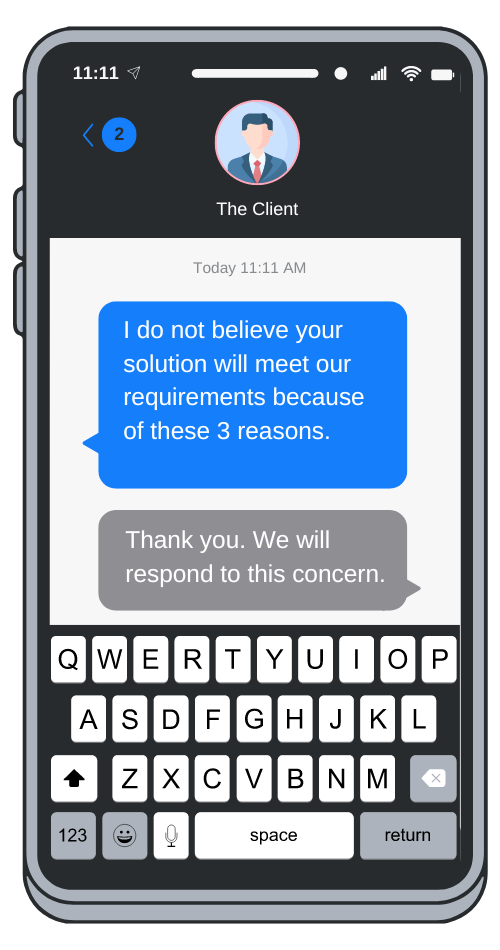
He agreed I had understood his concern and thanked me. I think it was the first time he had felt listened to in a while. I told him I would circle back with him in two days once I visited with the team.
Here’s what I think happened: He had raised this concern to a junior member of the team who didn’t know what to say. Feeling ignored, he started to raise his voice. But as he raised his voice, he raised the tension in the room. And when the tension in the room rose, the team shut down with fear. They could no longer hear what was being said. They stopped dialog and started debating.
Identifying the Root Cause
Using a conflict resolution framework by Fred Kofman:
There are three conditions necessary for a conflict:
- Disagreement
- A scarce resource
- A lack of process to distribute the resource.
If any one of these conditions is removed, the entire conflict is resolved.
The disagreement was evident.
Can we remove the disagreement without resolving it?
Removing the disagreement without resolving it is equivalent to lowering the standards of this member of the team.
If an airplane manufacturer lowers standards, people can die. If a surgeon lowers standards, patients can get injured or die. These are high consequence environments. High consequence environments cannot lower standards.
We too were working in a high consequence environment and could not allow the disagreement to dissipate without constructive resolution.
What is the scarcity?
As is often the case in knowledge work, the scarce resource was information.
We were closer to meeting the requirements than the client understood. The client knew things we didn’t know. And we knew things the client didn’t know. How can we mitigate this scarcity of information? With communication.
And the lacking process was communication. As the Blind and the Elephant fable goes, each person has a piece of information, and projects their local knowledge to the whole.

I needed to create an environment where we could challenge each other, share what we each know, and create a shared understanding of the entire elephant, the problem, and solution space. This mitigates the scarcity of shared information.
I created what I later learned is called a psychologically safe environment.
Building Psychological Safety
There were several other leaders helping calm the waters, some subscribe to this newsletter – and I see you and thank you for your support during this period and your continued friendship. I’m describing what I specifically did.
I started by calling every person on the team. There must have been 20 people. In each call I:
- Deepened the personal relationship
- Ensured we were aligned on the same goal
- Built confidence we would achieve this shared goal with a workshop designed for collaboration
- Proposed some team norms to guide this workshop
Phone Call Part 1: Cohesion – Professional Relationships
A team that knows each other communicates better.
Cohesion fosters trust, respect, and open communication.
Cohesion and friendship can both positively impact teamwork, but they are not the same.
Team cohesion focuses on professional goals and the collective success of the team. It is driven by shared objectives, mutual respect, and effective communication.
Friendship, on the other hand, is based on personal connections and shared interests outside of work. While friendships can enhance teamwork by fostering a positive work environment and improving morale, they are not essential for team success.
Cohesion can exist without friendship, as long as there is mutual respect and a shared commitment to the team’s objectives.
Cohesion is built like friendship, and I love this quote:
“We cannot tell the precise moment when friendship is formed. As in filling a vessel drop by drop, there is at last a drop which makes it run over; so in a series of kindnesses there is at last one which makes the heart run over.” – Ray Bradbury, Fahrenheit 451
We can probably directly substitute “Cohesion” for “Friendship” in this quote and it’ll apply perfectly.
I made a personal connection with each person in these phone calls. We caught up on past or upcoming vacation plans, our kids. I’m doing this out of genuine interest. I’m also building cohesion. Furthermore, it softens the startup in the conversation which will need to address the situation quite starkly. That part of the conversation will be difficult, and we both need to be calm enough to receive each other’s message. This took 5-10 minutes per call.
Phone Call Part 2: Alignment
Recall my definition of a team: “A stable group interdependent in achieving a shared goal.” In this part of the phone call, I assured commitment on a shared goal – both the infinite goal, and the finite goal.
“I think this got emotional because everybody just wants to get it right. That’s good. I just want to explain why I’m here: I am here to be your boss’s trusted partner in executing this high consequence mission (the infinite goal). And in order to do that, we need this project to be successful (the finite goal).”
Everybody’s response:
“Yeah man, that’s why I’m here too.”
So now we are aligned. That took 5 minutes per phone call.
Phone Call Part 3: Introduce a New, Transparent Process
“I agree with Chris’s question and that we should be able to answer it in no uncertain terms. And we have the answer and I’ll show everybody how we arrived at it. If you still disagree, we’ll get it right. I’m sure there are other questions we haven’t heard, and I intend to field these too. If you can make your team available for a week, I will do the same, and I will facilitate this in a workshop. I don’t know exactly what it will look like yet, I’ll need 2 weeks to figure this out. Can you set aside a week sometime after that 2-week preparation period for a face-to-face?”
I started by agreeing with the question that had been yelled over the phone, and that I was glad to have the question, and that we will answer it and any question we have not yet heard. I am making a commitment to listen. And I was hopeful they would return that courtesy.
I also wanted to build some confidence that we are closer to the right solution than some people think. We had not been very good at answering the questions that were asked. Some required analysis which would take time.
But we weren’t tracking the questions in a way that would allow us to reliably defer the answer to another time. This is the root of the frustration that was boiling over into anger.
Phone Call Part 4: Introduce Some Team Rules to Guide the Collaboration
“This is a high consequence environment, and we are the best at what we do. Nobody can challenge us but ourselves. So we have to challenge ourselves, it’s the only way we will improve. So that requires a mutual commitment to collaborate between each and every team member. I’m going to recommend a few team rules to ensure people feel safe to share what they know.”
- Improve the program/System/Process and this team at the same time. One cannot fall victim to the other.
- Afford everyone the assumption of best effort and best intentions.
- If you don’t know, say so. We’ll all learn together, and it will increase the team’s mutual understanding.
- Be empowered representatives and respect the decisions made by the team. Don’t back channel something you didn’t agree with.
- Make and recognize repair attempts. Spoken language is messy, we won’t always get it right. When we don’t, we apologize. And when someone apologizes, we accept it.
Implementing the Framework
My team and I flew to the West Coast on a Sunday to meet with the client. The client had assembled 6 or so empowered representatives. There were about 15 people in the room when we started at 7am on Monday. I thanked everyone for coming.
I recapped the statement we were aligned on and wrote it on the whiteboard.

I recapped the team rules and wrote them on the board.

I recapped the importance of defining this as a team:
“This is a high consequence environment, and we are the best at what we do. Nobody can challenge us but ourselves. So we have to challenge ourselves, it’s the only way we will improve. You are the team. Nobody outside of this room can fix our work. We’ve got to get it right here. If we make errors that leave this room, we’ll certainly address them, but it’ll be harder then. So let’s get it correct now.”
And I recapped the first question we had, and wrote it on the board.
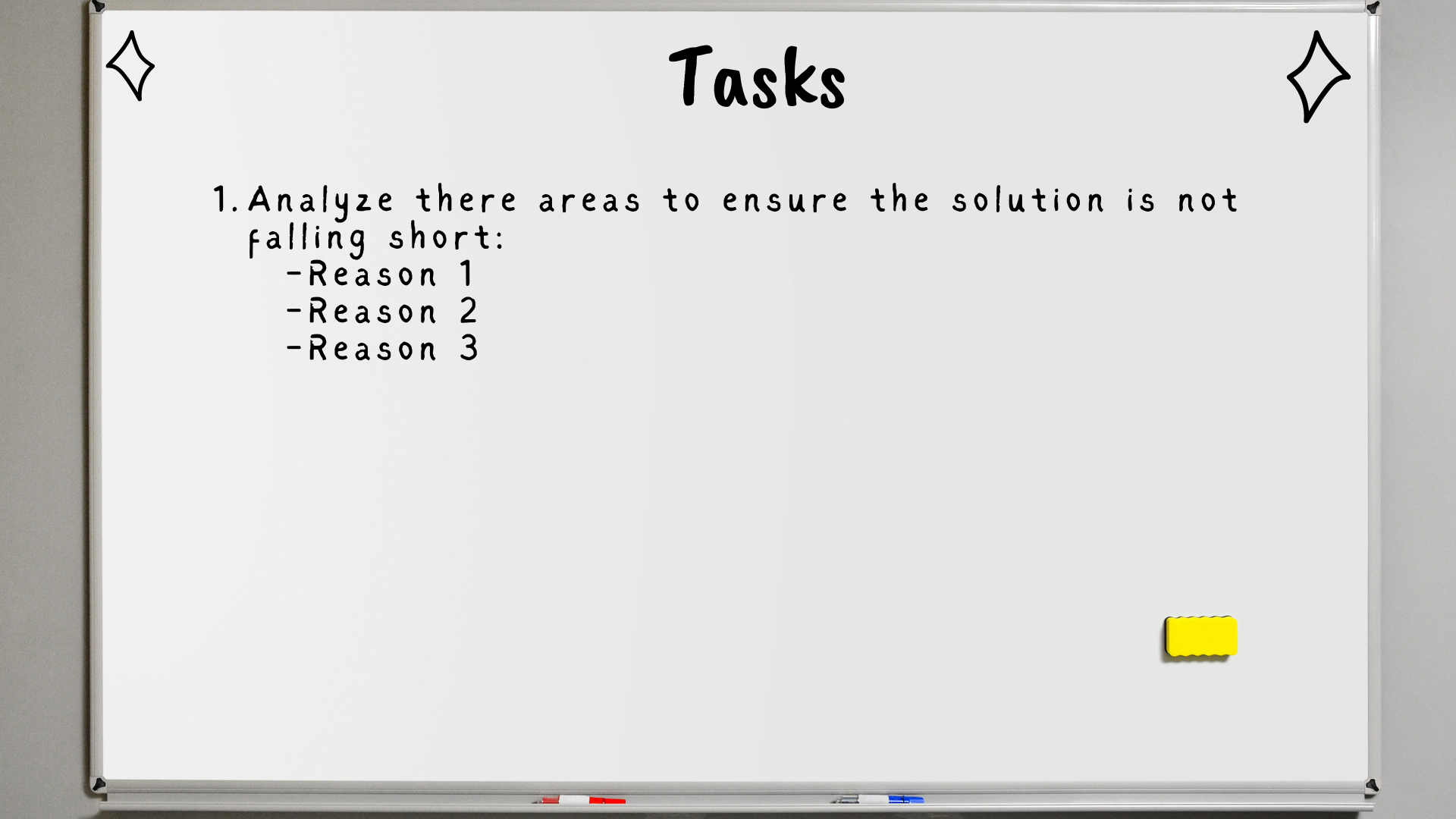
The stage was set.
Here’s what happened.
People would share a concern. I’d write it down on the whiteboard. I’d ensure I had captured it correctly. I’d see other people in the room nodding. At once, this is Active Listening and Transparency.
The group is starting to share what they know. They are starting to listen to each other. We are practicing divergent thought. Every single idea gets heard.
Once the heads were empty, we prioritized. Everybody got 3 votes, marked with a dot on the whiteboard. This is convergent thought. We are getting aligned on what we should do first. We had a top 3.
I asked people to volunteer for the first priority. Then the second. Then the third. Those three sub-teams would go off and work that question until they got it right. We reconvened at noon. Each team would nominate a speaker who reported back to the entire team with what they found, continuing the transparency. We’d capture any new problems. Vote on the next top 3. Volunteer. Move out.
At 4pm they’d report back. Write down any new problems. Vote on the next top 3 for the morning.
At 7am on Tuesday, we’d write down anything that kept people awake at night. Vote on the top 3. Go do. Report back.
And so on.
At 7am Wednesday, I played a joke on people. I didn’t show up. I came at 7:45 with donuts. The team presented the plan to me. They didn’t need me to facilitate any longer.
They were now a self-organized team.
On Thursday night, a team that yelled at each other for 3 months all joined me at a baseball game. The best ticket purchase I’ve ever made.
On Friday afternoon, the entire project was almost finished. There were a couple of remaining questions that could not be answered for good reasons – we needed another resource that wasn’t available until next week, that sort of thing.
The team that yelled at each other for 3 months nearly completed their project in 5 days.
We did not lower standards.
We increased safety.
Conclusion
The key to this transformation was restoring psychological safety, allowing the team to move from a culture of “bring your hate and discontent” to one focused on improving both the system and the team at the same time. This experience reinforced the importance of psychological safety in achieving team success.
🧠The Framework: Psychological Safety
Amy Edmondson’s book The Fearless Organization is full of bone chilling examples of organizations with psychological danger and inspiring stories of psychological safety.
She lays out this framework2:
Create shared expectations and meaning
Frame the work
Learning is the work. We get to perfect by failing along the way. Expect perfection at the end of the rainbow, and expect learning the entire way.
Emphasize Purpose
Ensure the team understand’s why this is important. What is at stake? Why does this work matter? For whom does it matter most? Put a face on it.
Build confidence that each voice is welcomed
Demonstrate Situational Humility
Create constructive tension between current reality and the desired goal.
Practice Inquiry
Ask questions about the work. Listen actively. Encourage everyone do the same.
Set up structure and processes
Create time and processes for capturing ideas, comments, and other input.
Build guidelines around these discussions to keep things on track.
Orient the team towards continuous learning
Express Appreciation
Thank individuals when things go well. Thank individuals when they find issues.
Destigmatize failure
Failure is learning. Frame failure in the larger goal. Look forward, provide resources, offer help.
Loop back to “Structure and processes” – discuss the failure, consider options, brainstorm next steps
Sanction clear violations
Safety can be broken quickly, and the culture is defined by the worst behavior the leader is willing to tolerate. Hold people accountbale for stepping outside of the culture.
And when someone steps outside of the culture, a repair including apology is warranted.
As illustrated by this 2×2 matrix, a team that has high standards and high safety has high performance.

📕1 Book, 🎧 1 Podcast, 📺1 Video, 📰1 Article
Here’s the best stuff I’ve found while researching this.
📕 Today’s Book
Amy Edmondson first defined Psychological Safety in her Post Doctoral work in 1999. She continues to be the leading voice on the topic. She points to research showing collaboration is up 50% in the last 20 years, and there is no better time to learn how to build Safety in your team. She shows that not all failures are equal – failures in known environments are avoidable, but failures in new fields should be expected. That new fields require intelligent failure which requires thoughtful preparation to make the failure as small as possible as intentional learning opportunities. And that Systems Thinking can help us elevate our decision making from “Hear and Now” to “Elsewhere and Later”. The Right Kind of Failure by Amy Edmondson. Please buy in your local bookstore. They won’t survive without you.
🎧Today’s Podcast:
Organizational Behavior superstar Adam Grant’s podcast: Are you afraid to share bad news, ask for help, or admit you were wrong? These are signs of being in a psychologically unsafe work environment. Adam breaks down the importance of psychological safety in preventing errors and promoting innovation and inclusion, and examines what it takes to build a culture of voice rather than silence. He speaks with Ed Pierson (Boeing), Amy Edmondson (Harvard Business School), Captain Bill Wilson and Admiral McRaven (US Navy). Listen Online Here: Worklife With Adam Grant or on Apple Podcasts. (37 minutes)
📺Today’s Video:
Simon Sinek describes a version of the 2×2 Psychological Safety matrix but as “Performance” and “Trust”. The Navy SEALs would rather have someone of Medium Performance and High Trust than someone as High Performance and Low Trust. I had posted one of my Psych Safety videos on Facebook and a friend sent this as a reply. It’s so good. Watch on YouTube here. (3 minutes)
📰Today’s Article:
Legendary NFL head coach Bill Parcells talks about turning a team around. He first turned the New York Giants around from winning only 3 games to winning two Superbowls in 6 years. He then turned around the New England Patriots from winning 3 games in 2 years to the Superbowl in 4 seasons. He talks about making sure people know you’re in charge, and acknowledges how hard that seems when surrounded by superstars. Read in Harvard Business Review Here
1: Edmondson, Amy C. The Fearless Organization: Creating Psychological Safety in the Workplace for Learning, Innovation, and Growth. Hoboken, New Jersey: John Wiley & Sons, Inc, 2019.
2: Edmondson (2019).

4 thoughts on “Saving a Team with Psychological Safety”