
High-performing teams are built, not born.
Most managers struggle because no one ever taught them how to lead.
Better teams don’t happen by accident.
That’s why I created Lighthouse Leadership—a podcast and newsletter for managers who want to lead with intention, not instinct.
🔊 Listen to the podcast for raw leadership stories and hard-won lessons from the field.
📬 Join the Sunday newsletter for actionable frameworks and tools to build better teams—one week at a time.
Let’s build better leaders and teams—together.
🎧 This Week on the Lighthouse Leadership Podcast
Real stories. Hard lessons. No fluff.


The Tough, but Rewarding Job of Management
- 60% of managers fail within their first 24 months.
- 86% of managers never receive formal training—they’re called accidental managers.
Why? Because they haven’t learned the four principles that drive team performance:
- Alignment on a common goal
- Transparent processes that enable focus and execution
- Psychological safety
- Cohesion
There aren’t just theories. They are evidence-based principles that separate struggling teams from elite performers.
Let’s start with some fundamental definitions.
The fundamental definitions
Team
/teem/ noun. A bounded, stable group of people interdependent on achieving a shared goal.
(Amy Edmonson)
Management
/man – ij – ment/ noun. The role responsible for delivering the desired results of an organization or a team.
The output of a manager is the output of the team.
(Andy Grove – High Output Management)
Project
/prä-jekt/, noun. A temporary endeavor undertaken to create a unique product, service or result. It has a specific objective, a defined start and end date, and employes human and non-human resources.
(Project Management Institute – PMI)
Leader
/lee – dr/ noun. Leaders create things that didn’t exist before. They do this by giving the tribe a vision of something that could happen, but hasn’t (yet).
(Seth Godin)
So the leader defines the project. The project is executed by the team. And the team is enabled by the manager.
And if the manager’s performance is measured by the output of the team, let’s look at team performance.
Most projects fail to deliver on their promises.

Bent Flyvbjerg, the world’s leading megaproject expert, analyzed 16,000 projects and found that only 0.5% delivered on time, within budget, and with promised benefits. He calls this the “Iron Law of Megaprojects: over budget, over time, under benefits—over and over again.”
“Iron Law of Megaprojects: over budget, over time, under benefits—over and over again.”
Bent Flyvbjerg
If the output of a manager is the output of the team, and the output of the team is project performance, then it’s no surprise that most projects fail.
But let’s be honest—managers aren’t set up for success.
Most new managers are thrown into leadership without training, without a framework, and without support. They’re expected to just “figure it out.” But without the right foundation, they end up firefighting—dealing with symptoms instead of fixing the root causes.
So what’s really driving poor project performance?
The underlying causes beneath this poor performance are consistent.
Every struggling team I’ve worked with faces the same four root causes of failure:
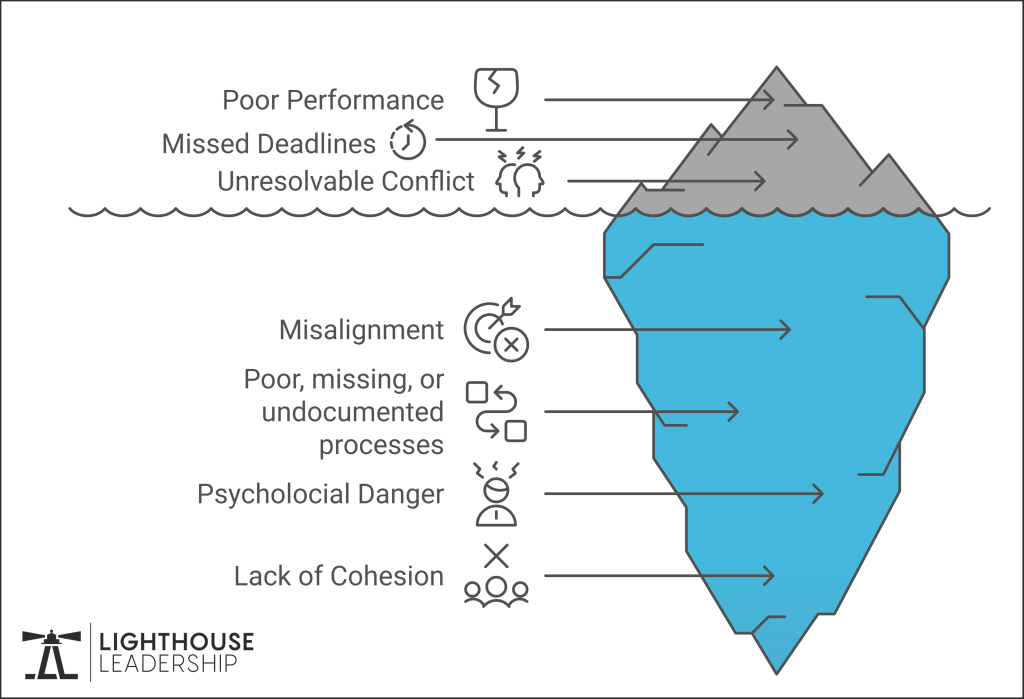
- Misalignment: The team doesn’t share the same picture of success. People assume they’re working toward the same goal, but their definitions don’t match.
- Broken or missing processes: to-do’s are tracked haphazardly making prioritization impossible; results come from individual effort rather than a team contribution.
- Psychological danger: Team members hesitate to speak up, challenge ideas, or ask for help. They don’t feel heard, so they disengage.
- Lack of Cohesion: Relationships are missing, people operate in silos, pointing fingers instead of working together. Trust is low, and communication is reactive, not proactive.
To borrow an idea from NFL Hall fo Fame coach Bill Parcells: To get results from that team you’ve got to impose your leadership.
I remember the first time I read this. I thought “Impose my leadership?? Where do I start??”
Now I know there are actually only 4 things to impose.
The antidote: Apply these four principles to build a high-performing team.
Most leadership challenges can be traced back to four core issues. When teams lack alignment, struggle with broken processes, operate in psychologically unsafe environments, or feel disconnected, performance suffers.
One of the biggest challenges leaders face is ensuring everyone is working toward the same outcome. Without alignment, even the most talented teams waste time pulling in different directions.
Thankfully, it’s also one of the easiest things to build with the right frameworks.
Alignment happens when every team member understands what needs to be done, why it matters, and who is responsible. It transforms scattered efforts into focused, high-impact execution.
The highest-performing teams—from NASA’s Apollo mission to Pixar’s creative powerhouse—excel because they align every project, process, and decision with a clear, shared goal. Learn how to build alignment in your team in our full guide. → What Is Alignment?
Transparent Processes That Enable Focus and Execution
Results without process are not repeatable. Process without results are futile.
A high-performing team isn’t just about talent—it’s about structured processes that allow teams to prioritize, collaborate, and execute effectively. Without clear workflows, priorities get lost, and teams rely on individual heroics rather than sustainable systems. Discover how to design scalable, efficient team processes in our upcoming processes pillar article.
One of the biggest challenges leaders face is creating an environment where people feel safe to speak up—to challenge ideas, ask questions, and admit mistakes. Without psychological safety, great ideas remain unspoken, mistakes go unaddressed, and innovation stalls.
The best teams—whether at Google, Pixar, or elite military units—deliberately foster psychological safety to encourage open dialogue and critical thinking. The difference between a high-performing team and a dysfunctional one often comes down to whether people feel safe enough to tell the truth.
A leader’s job is to create an environment where team members protect the team by sharing ideas—rather than protect themselves by staying silent. Learn how to cultivate psychological safety and unlock your team’s full potential in our complete guide. → Principle First: Defining Psychological Safety
Many leaders assume that once someone joins the team, they naturally integrate—but that’s rarely the case. New hires often struggle to find their place, and even seasoned team members can feel like outsiders. Cohesion isn’t just about working together; it’s about feeling connected, trusted, and valued.
The difference between a high-performing team and a group of individuals is belonging. True cohesion creates an environment where people don’t just fit in—they become part of something bigger. And that shift, from simply being present to feeling like an integral part of the team, is what unlocks trust, engagement, and performance.
Cohesion is built through shared experiences, meaningful connection, and vulnerability loops—small but critical interactions that strengthen trust. But when cohesion is neglected, teams fracture, engagement plummets, and performance suffers. Learn how to build a cohesive team and create an environment where people truly belong in our full guide on cohesion. → Building a Cohesive Team: The Bridge Between Fitting In and Belonging
Processes
Processes pillar article coming soon
5 Days to a High-Performing Team:
A free step-by-step email course to unlock your team’s potential.
I’m obsessed with what makes teams tick and how to unleash their full potential. Now, I’m sharing everything I’ve learned with you.
Take the guesswork out of leadership. Over 5 days, you’ll get practical insights and strategies to transform your team dynamics and build cohesion, performance, and productivity.
Here’s what’s inside:
- Day 1: Go from functioning to high-performing.
- Day 2: Know the 6 myths of teamwork, and the truth.
- Day 3: Unlock the hidden benefits of a great team.
- Day 4: How to foster team cohesion.
- Day 5: Use a proven framework to build your team.
Why sign up?
This course gives you everything you need to create a high-performing team.
As one participant said:
“If you’re looking for an effective way to reach your team’s full potential—fast, get Evan’s course now.”