This page brings together my most essential insights on building cohesion within your team or organization. I’ll explain what cohesion is, why it’s important, and how to build it. I’ve done my best to cover the fundamental principles of cohesion in a way that’s easy to absorb, even if you’re short on time.
At the end of this page, you’ll find a complete list of all the articles I’ve written on cohesion.
What is Cohesion?
Let's start with what it isn't.
I was on my way to meet with an executive when someone held the door for me. I thanked him.
“Can you tell me how to find the cafeteria?”
I stopped and introduced myself.
Monday was his first day at work. It was now Thursday. Nobody had shown him the cafeteria yet, and he had nobody to eat with on his fourth day of work.
I sent a text to the executive to cancel our meeting, telling her I’d explain later. Instead, I took this new hire to lunch.
When I later told the executive the story, she started to cry. “I can’t believe my business is treating people this way.”
Do NOT let this happen on your team.
Once a vulnerability loop is broken, the energy required to rebuild trust is significantly higher. That’s why leaders must model these behaviors—admitting when they don’t have all the answers, actively seeking input, and creating an environment where it’s safe to take risks.
Built connection from the start.
So let's define cohesion
Cohesion / kō – hē – zhən / noun. The act or state of sticking together tightly.
(Merriam-Webster)
Trust is an essential ingredient for any team.
Trust comes from cohesion—feeling known and valued by those around you.
Yet, team-building has been given a bad rap by surface level activities—trust falls, mandatory social events, and the like. These can create temporary bonds, they can move the needle, but true cohesion is built through meaningful connection, shared experiences, and a strong sense of belonging.
Here’s how it’s actually built and why I consider it fundamental.
The Difference Between Fitting In and Belonging
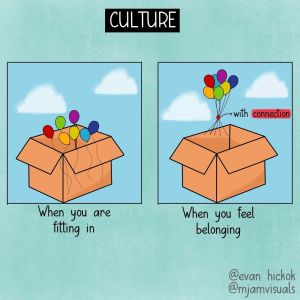
Many managers think all they need to do is assign someone to a team and their work is done. But this is missing a critical idea, the distinction between Fitting In and Belonging.
-
Fitting in: This is like being at some celebrity’s party – your in the door, but nobody cares you are there. You’ve gotten the job, but you feel on the outside.
-
Belonging: This is like being at your friends party. You are where you want to be, and others are glad you are there too.
A high-performing team is an elite unit – and people want to know they are part of it. They want to feel that sense of belonging.
The bridge between Fitting In and Belonging is Connection.
Let’s talk a bit about why belonging is such a powerful human force, and then we’ll talk about building it.
Building a Tribe
A tribe is a group of people connected to each other, a leader, and an idea.
Seth Godin
Humans have been tribal since humanity began. As hunter-gatherers, survival was uncertain. There were no farms or stores, early humans foraged for berries and trapped small animals. This took local knowledge and what could be eaten, what had to be avoided, and humans formed tribes to share this knowledge. Tribal knowledge. They would collaborate within their tribe to ensure mutual survival. And they would compete fiercely with those outside of their tribe.
This is why sports fans get so animated. I’ve been to baseball games in lots of stadiums across America – always wearing a Red Sox hat. I am greated by fellow Red Sox fans and jeered by the others. It’s what makes competition so fun. And it’s deep rooted, tribal behavior.
We have always collaborated with those inside our tribe and competed with those outside.
This is what makes connection so important in a team. Let’s talk about building it.
Vulnerability Loops: The Foundation of Connection
This concept sounds exotic, but you have experienced this many times.
To be vulnerable means to be capable of being physically or emotionally wounded.
When you walk into a café, make eye contact with someone, and they smile, they are making an invitation to connect. I call this a micro-connection. If this micro-connection is not reciprocated, the moment passes, and the opportunity for trust-building is lost, making it harder to establish connection later. And it is actually a signal of vulnerability—it feels awkward to smile at someone who doesn’t smile back. It’s embarassing.
I recently experienced this in a grocery store. I was looking for sugar down an aisle. I could see someone walking towards me in my periphery, I made eye contact and she had a vibrant smile. But I was still focused looking for sugar, I was a little surprised by her and I didn’t smile back. Later, when I saw her again in another aisle, she actively avoided eye contact. It was clear there was no way she was giving me a second change to make this conncetion. I had broken the vulnerability loop, she regretted ever making eye contact, and there was no way she was going to repeat that mistake.
Sound familiar?
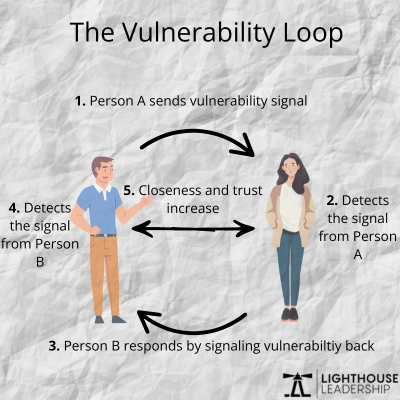
Here is How a Vulnerability Loop Works:
-
Person A signals vulnerability.
-
The signal is received by Person B.
-
Person B reciprocates with vulnerability in return.
-
Person A acknowledges this response.
-
The loop is closed, and trust increases.
How to Turn Your Team into a Tribe
To build cohesion, leaders must take deliberate steps:
-
Define team boundaries – Clearly list who is on the team, their roles, and responsibilities. A team should be bounded! I see this missed alot.
-
Maintain stability – Avoid frequent changes to team composition. It takes time for a team to gel, for cohesion to form. The team needs time to develop personal connections and trust.
-
Create connection actively – Coordinate activities that build trust and mutual understanding.
-
Foster vulnerability loops – Normalize openness, constructive feedback, and psychological safety.
-
Design onboarding for connection – When new people join the team, take time to actively build connection. This may feel like an interruption to the flow of work – but each person needs a technical mentor (here’s how we do things here) and a social mentor (here’s who everyone is and here is where the bar is).
Final Thoughts
Team building is not trust falls. It’s something bigger. And its not soft, it’s hard.
Here are are the articles I’ve written on Cohesion.




5 Days to a High-Performing Team:
A free step-by-step email course to unlock your team’s potential.
I’m obsessed with what makes teams tick and how to unleash their full potential. Now, I’m sharing everything I’ve learned with you.
Take the guesswork out of leadership. Over 5 days, you’ll get practical insights and strategies to transform your team dynamics and build cohesion, performance, and productivity.
Here’s what’s inside:
- Day 1: Go from functioning to high-performing.
- Day 2: Know the 6 myths of teamwork, and the truth.
- Day 3: Unlock the hidden benefits of a great team.
- Day 4: How to foster team cohesion.
- Day 5: Use a proven framework to build your team.
Why sign up?
This course gives you everything you need to create a high-performing team.
As one participant said:
“If you’re looking for an effective way to reach your team’s full potential—fast, get Evan’s course now.”